
INTRODUCTION
Anthelmintic resistance (AR) has gained increasing attention as an emerging global problem in veterinary medicine. It is the acquired capability of helminths to resist the action of anthelmintics in dosages that would normally kill them. AR poses one of the major threats to animal health, welfare, and farm productivity. Infections due to Livestock Helminths, especially Haemonchus contortus, Ostertagia ostertagi and Trichostrongylus species, result in heavy losses in cattle, sheep, and goat industries. The repeated, sometimes indiscriminate, use of dewormers has accelerated the selection pressure on parasites, leading to widespread resistance across multiple drug classes (Tenorio, 2025). In large parts of the world, resistance has reached a critical stage-in which common anthelmintic drugs, including benzimidazoles, imidazothiazoles, and macrocyclic lactones, are no longer fully effective. A scientific understanding of the mechanisms of AR, careful monitoring, and the adoption of integrated control strategies are required to address the problem at hand (Gatitu et al., 2025).
MECHANISMS OF ANTHELMINTIC RESISTANCE
The mechanisms of AR are complex and usually multifactorial. Most often, genetic mutations occur in the parasite population, changing drug target sites or modifying metabolic pathways. Specifically, two major categories of mechanisms include target modification and pharmacokinetic resistance.
Target Modification
Anthelmintic resistance occurs when genetic mutations in a parasite population change the structure of a specific drug receptor site. In susceptible worms, the drug binds to these receptors like a "key" in a "lock," triggering lethal effects like paralysis or metabolic failure. However, through natural selection, individuals with modified receptors survive treatment and pass these genes to their offspring. This modification might involve a single amino acid substitution (such as the F200Y mutation in β-tubulin for benzimidazoles) or the loss of specific receptor subunits entirely(Tenorio, 2025). The drug fails because it can no longer "fit" into the altered receptor, preventing it from attaching. Even if the drug binds, the receptor may no longer respond or transmit the signal needed to kill the parasite. The parasite may simply produce fewer receptors, giving the drug fewer targets to act upon. As a result, the parasite continues to feed and reproduce despite high doses of the medication, rendering the treatment ineffective and leading to the spread of resistant strains (Fissiha & Kinde, 2021).
Resistance to benzimidazoles, fenbendazole and albendazole, is strongly associated with single nucleotide polymorphism (SNPs) in the isotype 1 β-tubulin gene. This is the drug's target site, and a common substitution of phenylalanine to tyrosine at codon 200 prevents the drug from binding to the β-tubulin protein that it needs to disrupt cell division and motility (Dilks et al., 2020). Nicotinic Agonists such as levamisole, pyrantel, act on nicotinic acetylcholine receptors (nAChRs) which induce spastic paralysis in the worms. Resistance is mostly associated with a reduced expression or mutations in the genes encoding the nAChR subunits, leading to a receptor having a lower affinity for the drug. Macrocyclic Lactones (MLs), including ivermectin and moxidectin act against Glutamate-gated Chloride Channels (GluCls). They exhibit resistance either through mutations in these subunit genes or more commonly through mutations that affect drug transport (Geary & Moreno, 2012) .
Pharmacokinetic Resistance (Reduced Drug Concentration)
These mechanisms prevent the drug from reaching or staying at its target site long enough to be lethal. The parasite increases the activity or expression of efflux pump proteins, largely P-glycoproteins (P-gps). This is because these proteins act as a type of molecular pump in the cell membrane of the parasite which actively pumps out the anthelmintic drug out of the cell before it can reach the target. This is among primary mechanisms of resistance to Macrocyclic Lactones and it gives multi-drug resistance. An increase in the activities of enzymes in the breakdown or detoxification of the anthelmintic leads to a quick inactivation and excretion of the anthelmintic found in resistant populations of worms (Lespine et al., 2012).
Benzimidazole resistance arises due to single-nucleotide polymorphisms (SNPs) in the β-tubulin gene at codons 167, 198, or 200.These mutations prevent the drug from binding effectively to the microtubule structure, reducing its efficacy (Esteban-Ballesteros et al., 2017).
Levamisole is a common anthelmintic (dewormer) that works by targeting the nicotinic acetylcholine receptors (nAChRs) located on the muscle cells of parasitic nematodes. Under normal conditions, the drug acts as an agonist, mimicking acetylcholine to keep these receptors open. This causes a constant influx of ions, leading to prolonged depolarization, spastic paralysis, and the eventual expulsion of the worm from the host's body. Resistance occurs when the parasite undergoes genetic mutations that alter the composition or structure of these receptor subunits. Parasites may downregulate specific subunits (like unc-38 or unc-29) or express truncated versions, making the receptor less sensitive to the drug. Another mechanism is the change in the amino acid sequence at the binding site prevent Levamisole from "docking" effectively, even if the receptor is present. It may happen that the muscle membrane fails to depolarize because the modified receptors no longer allow sufficient ion flow to trigger a contraction (Vosála et al., 2025).
Ultimately, these changes allow the parasite to remain mobile and attached to the host's intestinal wall despite the presence of the medication. This molecular "remodeling" is a primary reason why rotating dewormer classes is essential in livestock management (Ibrahim, 2025).
| Method | Principle | Application | References |
|---|---|---|---|
| FECRT | Compare egg counts before and after treatment | Field-level efficacy check | Demeler et al., 2012 |
| Egg Hatch Assay | Detects benzimidazole resistance | Laboratory test | Demeler et al., 2012 |
| Larval Development Test | Assesses inhibition by drugs | Lab screening for resistance | Várady et al., 2007 |
| Molecular Assay | Detects resistance gene mutations | Advanced diagnostics | von Samson-Himmelstjerna, 2006 |
MONITORING ANTHELMINTIC RESISTANCE
The effect of the drugs is also monitored to ensure that it has been effective, allowing for the identification of resistant parasite populations early enough. The Faecal Egg Count Reduction Test (FECRT) is the most suitable instrument in the field setting, being supported by in vitro tests and molecular diagnostics (Levecke et al., 2018). The successful management of parasites requires various monitoring methods that evaluate the effect of the drug and the timely identification of resistance populations of worms (Table 1).
Faecal Egg Count Reduction Test (FECRT)
According to the FECRT is regarded as the gold standard in the field of farm monitoring of anthelmintic efficacy. It is an in vivo test-which means a test that quantifies resistance by comparing worm egg counts before and after treatment (Morgan et al., 2022). A statistically significant group of animals is selected, usually 10-15 per treatment group. Faecal samples from each animal are collected in order to establish a baseline FEC1. Only animals with sufficient parasite burden-in case of for example, typically >150 eggs per gram-are included in the test. All the selected animals are weighed accurately and a particular anthelmintic drug, the one under test is administered. Accurate dosing is essential because under-dosing can create the appearance of resistance. Collections of a second set of faecal samples (FEC2) from exactly the same animals, at an interval depending on a drug-specific time, for instance, Benzimidazoles after 10–14 days and Macrocyclic Lactones after 7–10 days. The FEC1 and FEC2 samples undergo laboratory analysis in order to measure the average egg count per gram of faeces by the modified McMaster technique. The percentage reduction in egg count is determined by the following formula (Levecke et al., 2018);
FECRT (%)= 100 ×(1-Post treatment Mean FECPre treatment Mean FEC )
If the faecal egg count reduction test (FECRT) result is greater than 95%, the anthelmintic is interpreted as effective, meaning the drug is highly effective; in this situation, you can continue using the same drug, but you should implement strategic mitigation measures to slow the development of resistance. If the FECRT result is less than 95%, resistance is suspected because the drug is failing and resistance is likely present; in this case, an immediate change to a different drug class is required, and the integrated parasite management (IPM) strategy should be updated accordingly (Rashid et al., 2018; Mickiewicz et al., 2021).
Egg Hatch Assay (EHA)
The working principle of EHA is based on the mode of action of Benzimidazoles, which is to inhibit the polymerization of microtubules in the parasite's cells. This prevents the cell division necessary for egg development into a larva and eventual hatching. Fresh parasite eggs are isolated from the faeces of infected animals. The eggs are incubated in microtiter plates with different, known concentrations of the benzimidazole drug (e.g., thiabendazole or albendazole). The plates are incubated for a set period-usually 24 to 48 hours-under specified conditions of temperature and humidity to allow normal development and hatching. Under the microscope, the number of unhatched eggs (which fail to develop) and hatched larvae are counted (Giordani et al., 2017).
The Benzimidazole drug at therapeutic concentrations will prevent almost all eggs from hatching in a susceptible parasite population. However, this will not happen even at high concentrations in a resistant population, which is a mutation in its beta-tubulin target site. The EHA is often quicker and less expensive than the FECRT; however, it provides information on benzimidazole resistance mechanisms only (Levecke et al., 2018).
MITIGATION OF ANTHELMINTIC RESISTANCE
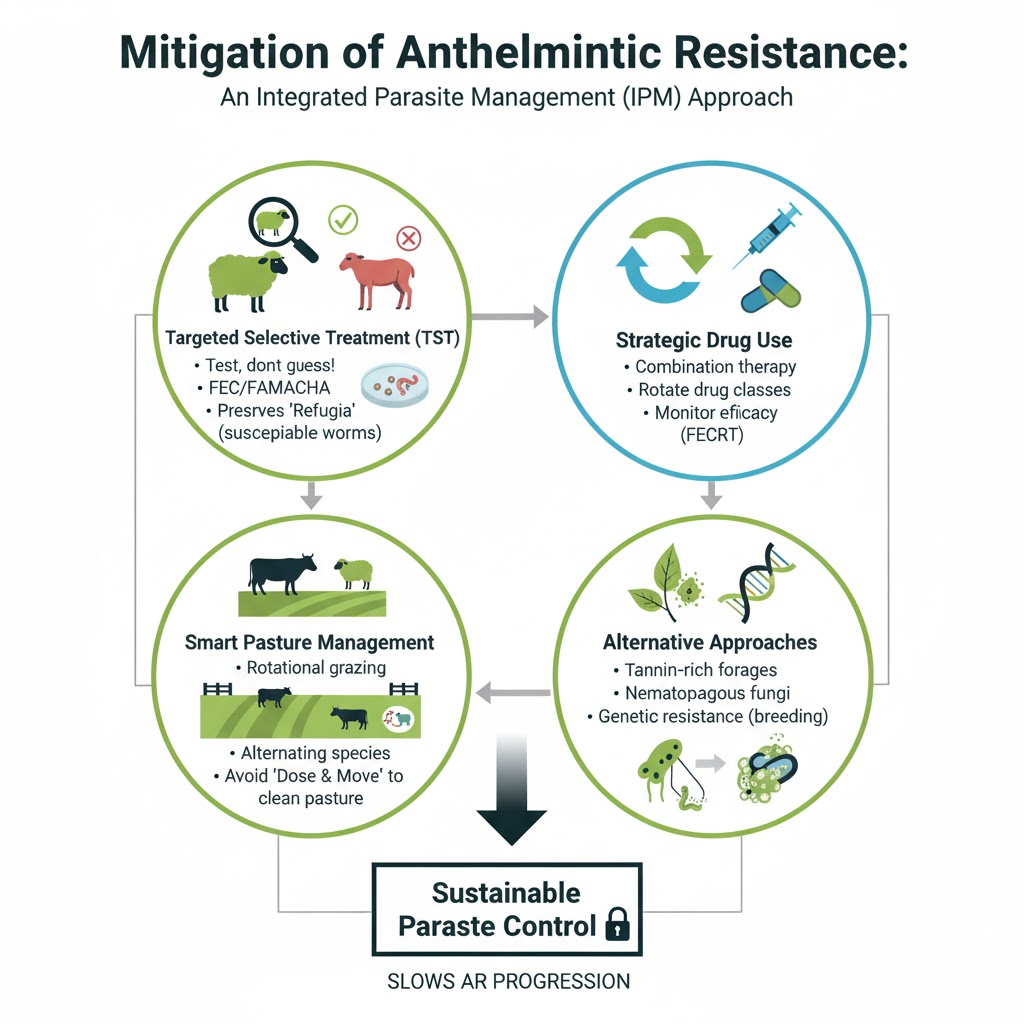
Although AR is a genetic change that cannot be reversed once resistant genes are established in the parasite population, we can significantly delay its advancement and preserve the effectiveness of the drugs we still have (Fig. 1). The key to this is moving away from the old practice of "blanket treating" all animals and adopting an Integrated Parasite Management approach that combines strategic drug use with farm-management practices (Table 2; Hunt et al., 2010).
Targeted Selective Treatment (TST)
Instead of dosing every animal regardless of its infection level a practice that exposes susceptible worms unnecessarily, TST is about treating the individual, not the flock. By only treating animals with high faecal egg counts as determined by a Faecal Egg Count that show clinical signs-including anemia, which is checked by tools such as the FAMACHA system, you greatly reduce the total amount of drug applied. This is the core of preserving “refugia”. Refugia refers to the large population of susceptible worms which either remain in the host untreated or are free-living on pasture. These susceptible worms dilute the gene pool of the resistant survivors and thus reduce the speed at which resistance spreads through the next generation (Harris, 2021).
Strategic Drug Rotation and Combination
The objective of this practice is to prevent the worms from adapting to a single chemical attack. Traditionally, this means a yearly switch in drug classes. The more modern approach, however, is often to use in combination two or more effective classes of drugs simultaneously-a "cocktail". Using two different classes at once is often more effective than rotation because this requires a parasite to be resistant to both drugs at the same time, something which is genetically far less likely. If rotation is used, then this needs to be based on diagnostic testing (FECRT) to ensure the newly introduced class is 100% effective (Harris, 2021).
| Strategy | Description |
|---|---|
| Drug Rotation | Alternate between drug classes to reduce selection pressure. |
| Accurate Dosing | Weigh animals to ensure correct dosage. |
| Refugia Maintenance | Leave a proportion of untreated animals to preserve susceptible genes. |
| Targeted Selective Treatment | Treat only high-risk or high-burden animals. |
| Pasture Management | Rotate grazing and avoid overstocking to break parasite cycles. |
Smart Pasture Management
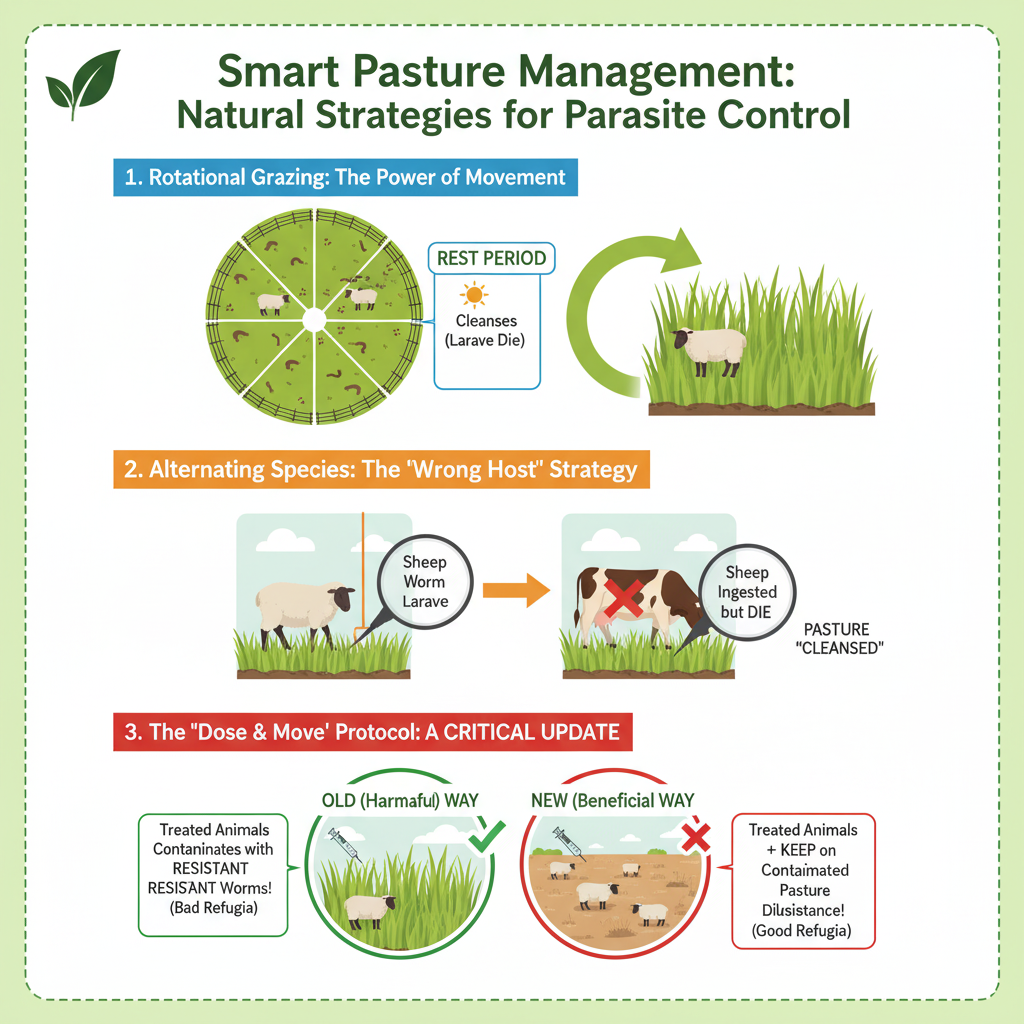
The goal here is simple, break the worm's lifecycle outside the animal. By making the pasture a less hospitable place for parasite larvae, we reduce the number of worms animals ingest, which in turn reduces the need for dewormers (Fig. 2). That's where truly sustainable parasite control happens. If animals are left in one area for a long period, they re-infect themselves constantly from their own droppings, building up huge levels of infective larvae (Hart & Hart, 2018). Under rotational grazing, you divide your paddock into small paddocks. Animals are grazed intensely on one paddock, only to be rotated to the next in a few days up to a week. The paddock that was previously grazed is then rest periodically, in some cases in weeks or even months before animals resume grazing. This rest is essential in enabling the sunshine, drying and natural decomposition to eliminate a massive percentage of the larvae of the parasite on the pasture. The larval numbers are reduced drastically when animals go back to the pastures and this in fact provides the animals with a cleaner start and less burden of worms. This can be compared to allowing the sun and wind to disinfect the play ground by themselves, then sending the children back (Gabrovska-Evstatieva & Evstatiev, 2022).
One of nature's most elegant solutions, leveraging the specificity of parasites is alternating species (Co-or alternating grazing). Most significant internal parasites are host-specific; sheep worms generally don't thrive in cattle, and vice-versa. When you have sheep and cows you can use them as biological vacuum cleaners. Now take a case, where a pasture is grazed by some sheep, and then they are removed. Take in cattle and set them in the same pasture. The sheep parasite larvae will be consumed by the cattle, however, none of them will transform into mature worms due to the fact that they are not adapted to cattle. They actually lose their way into the wrong host and are killed. This process purifies the pasture of infective larvae without dewormer using a single drop of dewormer. It interrupts the cycle when timely it interrupts the life of both species (Gabrovska-Evstatieva & Evstatiev, 2022).
ALTERNATIVE AND NON-CHEMICAL APPROACHES
As drug efficacy declines, sustainable solutions that reduce reliance on chemicals become essential. Certain plants (e.g., Chicory, Sulla, and various shrub legumes) contain condensed tannins, which have a natural anti-parasitic effect. Feeding these forages can reduce worm burdens and egg shedding. A promising option is using natural predators, nematophagous fungi, a biological control, which can be fed to livestock. The fungi spores pass through the animal and colonize the feces on the pasture, where they trap and kill the worm larvae before they can become infective. Selecting and breeding animals that naturally exhibit a higher degree of immunity and lower faecal egg counts is a long-term, permanent solution to reducing the parasite burden on the entire farm (Mendoza-de Gives, 2022).
CASE STUDIES ON ANTHELMINTIC RESISTANCE
Anthelmintic resistance (AR) has emerged as one of a major limitations to parasite control that is sustainable in livestock worldwide. Many case studies that are field-based show how resistance develops, how systematic monitoring can help in its detection, and how its development can be decelerated through combining mitigation approaches. Resistance, in South Asia, has been extensively reported in small ruminants. In Pakistan, a field study showed decreased efficacy of benzimidazoles against Haemonchus contortus in flocks of sheep, as determined by tests like faecal egg count reduction (FECRT) and in vitro analysis. The study reported pronounced decreases in egg count reductions, confirming the presence of populations of resistant parasites and focusing on the results of long-term deworming in routine use without monitoring of parasitological (Qamar & Alkheraije, 2023).
A similar scenario in India’s Kashmir Valley was reported, which documented numerous anthelmintic resistance in goats involving benzimidazoles, ivermectin, and closantel. FECRT values were under the recommended thresholds and were braced by molecular detection of β-tubulin mutations, which were liked with resistance. This showed that reliance on a small number of classes of drugs had increased resistance selection (Allaie et al., 2018). In Europe, the first confirmed case was reported. It was of multi-drug resistance in dairy goats in Romania. The FECRT, egg hatch tests, and larval development assays demonstrated resistance to both benzimidazoles and macrocyclic lactones while levamisole remained effective and potent. Some treatments, alarmingly, resulted in negative values of FECRT, specifying that resistant worms proliferated after the treatment due to the elimination of susceptible parasites (Potârniche et al., 2021). Almost the same findings have been revealed in Australia, where resistance to macrocyclic lactones in gastrointestinal nematodes was spotted, including Ostertagia spp., in pasture-based cattle systems. These results emphasize that AR is not narrowed to small ruminants but is also a growing concern in the cattle business (Mauger et al., 2022).
Across these studies, one test that emerged as the cornerstone of resistance monitoring is the faecal egg count reduction test (FECRT). The values of FECRT below 95%, in accordance with WAAVP guidelines, continuously indicated decreased efficacy and suspected resistance. Several studies combined FECRT with molecular assays, detecting resistance associated with polymorphisms of single nucleotide such as the mutation of F200Y in the β-tubulin gene of H. contortus. The combination of phenotypic and genotypic diagnostics has demonstrated that early detection and accurate characterization of resistance patterns is essential (Kapo et al., 2024). Various case studies, past documenting resistance, exemplify effective mitigation techniques. In Southern Thailand, FECRT was combined with molecular monitoring to assess different control strategies in meat goats. The authors highlighted a reduction in treatment frequency, rotation of drug class and targeted selective treatment (TST) as benchmarks to restrict further development of resistance (Sontigun et al., 2025).
A specifically demonstrative case of long term mitigation arises from breeding programs that target Haemonchus contortus. Studies on sheep populations that were genetically resistant revealed that choosing animals with smaller faecal egg counts and greater packed cell volume (PCV) remarkably lowered parasite burdens gradually. Farmers maintained refugia by not treating the resilient animals, which means diluting resistance genes in the environment (Estrada-Reyes et al., 2019). The FAMACHA-based targeted selective treatment approach has also been widely validated as a practical on-farm tool. By treating only anaemic animals rather than entire flocks, this strategy reduces drug use, slows resistance selection, and preserves anthelmintic efficacy (Walker et al., 2015). These case studies, collectively, show that blanket deworming in routine without monitoring is a major cause of multi-drug resistance. Strategic supervision and integrated management can alleviate its impact. Regularly testing for FECRT, incorporating molecular diagnostics, strategies for selective treatment, management of pasture and genetic selection for host resistance act for solutions based on evidence to a growing problem of the World (Van Wyk, 2008). Without such measures, basic anthelmintic drugs are at risk of becoming ineffective which is threatening for animal health, production of farm and livestock systems that are sustainable (Allaie et al., 2018; Qamar & Alkheraije, 2023). An integrated control program driven by the community was started which involved local farmers, veterinarians, and agricultural officers. Grazing in rotation, reduced frequency of deworming, and periodical monitoring of FECRT to guide for the choice of drug were the strategies which were included.
CONCLUSION
Anthelmintic resistance speaks for a conclusive crossroad for control of parasite in livestock systems. It demands a fundamental transposition from practices that were reactive and drug-dependent to management that is proactive and based on evidence. As mentioned throughout this chapter, resistance is not an isolated pharmacological failure but an evolutionary consequence that is predictable due to constant pressure of selection steered by blanket treatments, insufficient dosing, and inadequate monitoring. The combination of worldwide case studies clearly shows that early detection of resistance can be done and its progression can be slowed significantly by using tools for routine surveillance such as FECRT combined with molecular diagnostics and strategic planning.
References
- Allaie I, R Shahardar, S Trambo et al., 2018. Prevalence of gastrointestinal nematodes in small ruminants of Kashmir valley. Journal of Entomology Zoology Studies 6:2554-9.
- Demeler J, N Kleinschmidt, U Küttler et al., 2012. Evaluation of the egg hatch assay and the larval migration inhibition assay to detect anthelmintic resistance in cattle parasitic nematodes on farms. Parasitology International 61:614-8.
- Dilks CM, SR Hahnel, Q Sheng et al., 2020. Quantitative benzimidazole resistance and fitness effects of parasitic nematode beta-tubulin alleles. International Journal for Parasitology: Drugs and Drug Resistance 14:28-36.
- Esteban-Ballesteros M, FA Rojo-Vázquez, P Skuce et al., 2017. Quantification of resistant alleles in the β-tubulin gene of field strains of gastrointestinal nematodes and their relation with the faecal egg count reduction test. BMC Veterinary Research 13:71.
- Estrada-Reues ZM, Y Tsukahara, RR Amadeu et al., 2019. Signatures of selection for resistance to Haemonchus contortus in sheep and goats. BMC Genomics 20:735.
- Fissiha W & MZ Kinde, 2021. Anthelmintic resistance and its mechanism: a review. Infection and Drug Resistance 14:5403-10.
- Geary T & Y Moreno, 2012. Macrocyclic lactone anthelmintics: spectrum of activity and mechanism of action. Current Pharmaceutical Biotechnology 13:866-72.
- Gabrovska-Evstativea K & B Evstatiev, 2022. Overview of methods and technologies used for smart management of pastures and meadows. AIP Conference Proceedings. AIP Publishing LLC, 040011.
- Gatitu L, MR Kasudi, S Gitthigia et al., 2025. Anthelmintic resistance in livestock in Africa: review of the current status. BMC Veterinary Research 21:615.
- Giordani C, GH Marin, D Perez et al., 2017. Mechanism of action of drugs with activity against multicellular parasites. Parazitologiya 51:265-82.
- Harris J, 2021. The Impacts of Pasture Management Techniques in Grazing Lamb Systems. Mater thesis, Penn State University, USA.
- Hart BL & LA Hart, 2018. How mammals stay healthy in nature: the evolution of behaviours to avoid parasites and pathogens. Philosophical Transactions of the Royal Society B: Biological Sciences 373:20170205.
- Holden-Dye L & R Walker, 2014. Anthelmintic drugs and nematocides: studies in Caenorhabditis elegans. WormBook, ed. The C. elegans Research Community, WormBook, doi:10.1895/wormbook.1.143.2, http://www.wormbook.org.
- Hunt P, A Matinelli, K Modrzynska et al., 2010. Experimental evolution, genetic analysis and genome re-sequencing reveal the mutation conferring artemisinin resistance in an isogenic lineage of malaria parasites. BMC Genomics 11:499.
- Ibrahim B, 2025. Immunity and pathogenesis in parasitic infections: molecular basis and applications. In: Advances in Parasitology (Smith J, ed.): Academic Press, London, England, pp:60-77.
- Kaminsky R, P Ducray, M Jung et al., 2008. A new class of anthelmintics effective against drug-resistant nematodes. Nature 452:176-80.
- Kapo N, J Omeragić, Š Goletić et al., 2024. First report of benzimidazole resistance in field population of Haemonchus contortus from sheep, goats and cattle in Bosnia and Herzegovina. Pathogens 13:77.
- Lespine A, C Ménez, C Bourguinat et al., 2012. P-glycoproteins and other multidrug resistance transporters in the pharmacology of anthelmintics: prospects for reversing transport-dependent anthelmintic resistance. International Journal for Parasitology: Drugs and Drug Resistance 2:58-75.
- Levecke B, RM Kaplan, SM Thamsborg et al., 2018. How to improve the standardization and the diagnostic performance of the fecal egg count reduction test? Veterinary Parasitology 253:71-8.
- Liu M, SK Panda & W Luyten, 2020. Plant-based natural products for the discovery and development of novel anthelmintics against nematodes. Biomolecules 10:426.
- Mauger M, G Kelly, C Annandale et al., 2022. Anthelmintic resistance of gastrointestinal nematodes in dairy calves within a pasture-based production system of South West Western Australia. Australian Veterinary Journal 100:283-291.
- Mendoza-De Gives P, 2022. Soil-borne nematodes: impact in agriculture and livestock and sustainable strategies of prevention and control with special reference to the use of nematode natural enemies. Pathogens 11:640.
- Morgan ER, C Lanusse, L Rinaldi et al., 2022. Confounding factors affecting faecal egg count reduction as a measure of anthelmintic efficacy. Parasite 29:20.
- Potârniche A, M Mickiewics, D Olah et al., 2021. First report of anthelmintic resistance in gastrointestinal nematodes in goats in Romania. Animals 11:2761.
- Qamar W & KA Alkheraije, 2023. Anthelmintic resistance in Haemonchus contortus of sheep and goats from Asia--A review of in vitro and in vivo studies. Pakistan Veterinary Journal 43:376-87.
- Rashid MH, JL Vaughan, MA Stevenson et al., 2018. Anthelmintic resistance in gastrointestinal nematodes of alpacas (Vicugna pacos) in Australia. Parasites & Vectors 11:388.
- Sivajothi S, 2017. Therapeutic efficacy of closantel against different gastrointestinal parasites in sheep. Archives of Parasitology 1:1-3.
- Sontigun N, C Sansamur, T Klong-Klaew et al., 2025. Field-based and molecular evaluation of anthelmintic resistance in gastrointestinal strongyle nematodes of meat goats in Southern Thailand. Veterinary World 18:2467.
- Tenorio JC, 2025. Drug resistance in parasites: a review of mechanisms, drivers, and mitigation strategies. Microbes and Infectious Diseases 6:6152-6160.
- Van Wyk JA, 2008. Production trials involving use of the FAMACHA© system for haemonchosis in sheep: preliminary results. Onderstepoort Journal of Veterinary Research 75:331-45.
- Várady M, P Čudeková & J Čorba, 2007. In vitro detection of benzimidazole resistance in Haemonchus contortus: egg hatch test versus larval development test. Veterinary Parasitology 149:104-10.
- Von Samson-Himmelstjerna G, 2006. Molecular diagnosis of anthelmintic resistance. Veterinary Parasitology 136:99-107.
- Vosála O, J Krátký, P Matoušková et al., 2025. Biotransformation of anthelmintics in nematodes in relation to drug resistance. International Journal for Parasitology: Drugs and Drug Resistance 27:100579.
- Walker JG, M Ofithile, FM Tavolaro et al., 2015. Mixed methods evaluation of targeted selective anthelmintic treatment by resource-poor smallholder goat farmers in Botswana. Veterinary Parasitology 214:80-8.