
INTRODUCTION
Since ancient times, herbal medicines have been used in veterinary medicine for treating infectious diseases, improving feed efficiency, and enhancing immunity in animals. With growing concerns about drug residues and antimicrobial resistance in animal products, veterinarians are increasingly turning toward phytogenic and herbal alternatives (Kuralkar & Kuralkar, 2021). However, the reliability of herbal medicines depends heavily on their purity, consistency and quality. Standardization and quality control form the cornerstone of ensuring that these products are safe, effective, and reproducible (Govindaraghavan & Sucher, 2015, Wang et al., 2023). Unlike synthetic pharmaceuticals, which are single-compound preparations, herbal drugs are complex mixtures containing multiple chemical constituents. Due to the presence of poly-herbs, their quality control is more challenging (Zhang et al., 2012). Factors such as plant species, harvesting season, drying, storage, geographical source, and processing methods significantly affect phytochemical profiles.
QUALITY CHALLENGES IN HERBAL VETERINARY MEDICINES
Quality issues in herbal products stem from two primary bases: external challenge and internal challenge. External challenge is the contamination caused by outer sources such as heavy metals, pesticide residues, microbial pathogens, and adulteration with synthetic drugs (Table 1). Internal challenges are caused by inherent variability in plant chemistry, improper harvesting, and degradation of bioactive compounds during storage. These issues may result in reduced therapeutic efficacy or unexpected toxicity. To overcome such problems, protocols of standardization must be established at every step, from cultivation to the finished formulation (Zhang et al., 2012).
HERBAL DRUG STANDARDIZATION PROCESS
Raw Material Authentication and Quality Control
The basis is foundational in that it addresses changes caused by climate, soil, harvesting, etc. Organoleptic Examination of the parts of the plant (leaves, roots, bark, etc.) is carried out to assess its size, shape, color, odor, and taste. Examination of cell structures, tissue, and other features, such as stomata or trichomes, under the microscope is conducted (Table 2). DNA barcoding utilizes advanced molecular techniques that confirm the identity of the species and avoid impurities in the sample. Measuring moisture content is related to stability, as high moisture may promote microbial growth or degradation of the compound(Organization, 1998). Extractive Values measure the extent of soluble compounds. It is the quantity of chemical constituents extracted by various solvents, e.g., water, alcohol(Sahare et al., 2025). It is also necessary that the crude drug is free from non-plant materials, insects, or mold (Govindaraghavan & Sucher, 2015). Ash values, total ash, and acid-insoluble ash is the measure of inorganic content and is helpful in detecting contamination with soil or sand (Zhang et al., 2012).
Testing of Contaminants (Safety Assessment)
This ensures that the entity is free from all contaminants and consumptions. Testing for toxic elements like lead, arsenic, mercury, and cadmium is required to find the presence of heavy metals (Wang et al., 2023). It must be ensured that pesticides are within the safe limits. Testing for the presence of bacteria, fungi, or yeast contamination, including but not limited to E. coli or Salmonella, is also essential. Screening for toxic compounds, mycotoxins, produced by fungi, common examples include aflatoxins, is also helpful (Kosalec et al., 2009, Pallarés et al., 2022).
Chemical Standardization and Profiling (Potency and Consistency)
| Contaminant Type | Examples | Analytical Methods | References |
|---|---|---|---|
| Heavy Metals | Lead, Cadmium, Mercury, Arsenic | Atomic Absorption Spectroscopy (AAS), ICP-MS | (Shchukin et al., 2020) |
| Pesticides | DDT, Lindane, Organophosphates | Gas Chromatography-Mass Spectrometry (GC-MS) | (Wondimu & Geletu, 2023) |
| Microbial Load | E. coli, Salmonella spp., Aspergillus spp. | Plate Count Method, PCR-based Assays | |
| Mycotoxins | Aflatoxin B1, Ochratoxin A | High-Performance Liquid Chromatography (HPLC) | (Lai et al., 2014) |
| Adulterants | Undeclared drugs (e.g., steroids, NSAIDs) | LC-MS/MS Screening | (Mpanyakavili et al., 2022) |
This step highlights the active chemical components of the herb (Wang et al., 2023). This includes phytochemical screening (Fig. 1), which is a preliminary test to identify major chemical groups (e.g., alkaloids, flavonoids, tannins). And also chromatographic fingerprinting, creating a chemical "signature" or profile of the extract using techniques like TLC (Thin-Layer Chromatography), HPTLC (High-Performance TLC), HPLC (High-Performance Liquid Chromatography), GC-MS (Gas Chromatography-Mass Spectrometry) (Noviana et al., 2022). This ensures the consistency of the pattern of chemical compounds between batches(Xie et al., 2006). The marker compound quantification assay is used to ensure the consistency, potency, and dosage of known active ingredients by measuring their concentration (Govindaraghavan & Sucher, 2015).
Finished Product Evaluation
It is the evaluation of the final dosage form (tablet, capsule, syrup, etc.) according to the standards. Measurement of disintegration/dissolution time ensures the product breaks down properly for absorption (Hasan et al., 2017). Weight/volume uniformity is observed, which guarantees consistent dosing. Shelf life and proper storage conditions are evaluated for the certainty of stability (Kim et al., 2019).
GOOD AGRICULTURAL AND COLLECTION PRACTICES - GACP
The foundation of quality herbal medicine begins at the level of cultivation. GACP guidelines guarantee that plant cultivation occurs under standardized environmental conditions. This involves proper identification of the species, avoiding polluted soil or water, and using minimal pesticides. Harvesting time is aligned with the optimal phytochemical maturity of the plant. Post-harvest handling, like controlled drying, shade preservation, and airtight storage, maintains active constituent integrity (Singh & Baldi, 2018). The authentication will be supported by training field workers, Herbarium specimens for reference, and documentation to ensure traceability of raw materials used in the veterinary formulations (Organization, 2003).
| Method | Uses | Advantages | References |
|---|---|---|---|
| Raw Material Selection & Collection | Proper species identification, geographical location, harvest time, proper drying, and storage. | Right Plant, Right Time | Organization, 2003 |
| Authentication & Identity | Macroscopic/Organoleptic (Colour, odour, taste, fracture). Microscopic (Cellular structure, tissue type). DNA Barcoding. | Identity & Purity | |
| Physicochemical Evaluation | Foreign Matter (absence of non-plant material). Ash Values (Total, Acid-Insoluble). Moisture Content. Extractive Values. | Quality of Crude Drug | Organization, 2011 |
| Extraction & Formulation | Appropriate solvent and method selection (e.g., maceration, percolation, decoction). Good Manufacturing Practices (GMP). | Consistent Preparation | Khanal et al., 2018 |
| Safety/Contaminant Testing | Heavy Metals (Pb, As, Hg, Cd). Pesticide Residues. Microbial Load (Bacteria, Fungi). Aflatoxins/Mycotoxins. | Safety & Toxin-Free | |
| Authentication & Identity | Macroscopic/Organoleptic (Colour, odour, taste, fracture). Microscopic (Cellular structure, tissue type). DNA Barcoding. | Identity & Purity | Techen et al., 2014 |
GOOD MANUFACTURING PRACTICE-GMP
GMPs are high levels of standards and procedures that ensure that herbal products are manufactured and controlled constantly with respect to quality parameters throughout the manufacturing phase. In herbal veterinary medicines, this is an important aspect because manufacturing steps can introduce contamination or degrade the active complex components (Wang et al., 2023). GMP requires the adoption of validated conditions of extraction, such as the use of the right solvent and temperature and checks on batch uniformity. This makes sure that the amount and quality of the final product, whether it be in tablet, extract, or powder form, is the same from one run of manufacture to the next (Rastogi et al., 2015).
Application of strict GMP controls is mandatory for decreasing contamination risks. This includes safety from cross-contamination, which is the avoidance of mixing ingredients or products with others; for example, cleaning equipment properly between batches. Moreover, avoiding microbial hazards to maintain strict hygiene and environmental control that keeps the microbial load low, hence preventing the contamination of either pathogen or fungus (Zhang et al., 2012). GMP requires meticulous record-keeping for the purpose of full traceability of the raw materials, intermediate extracts, and the finished formulation. This link is important in relation to public health, as it helps regulatory bodies act swiftly in identifying and taking defective batches off the supply chain when an adverse event is reported (Vidhamaly et al., 2022).
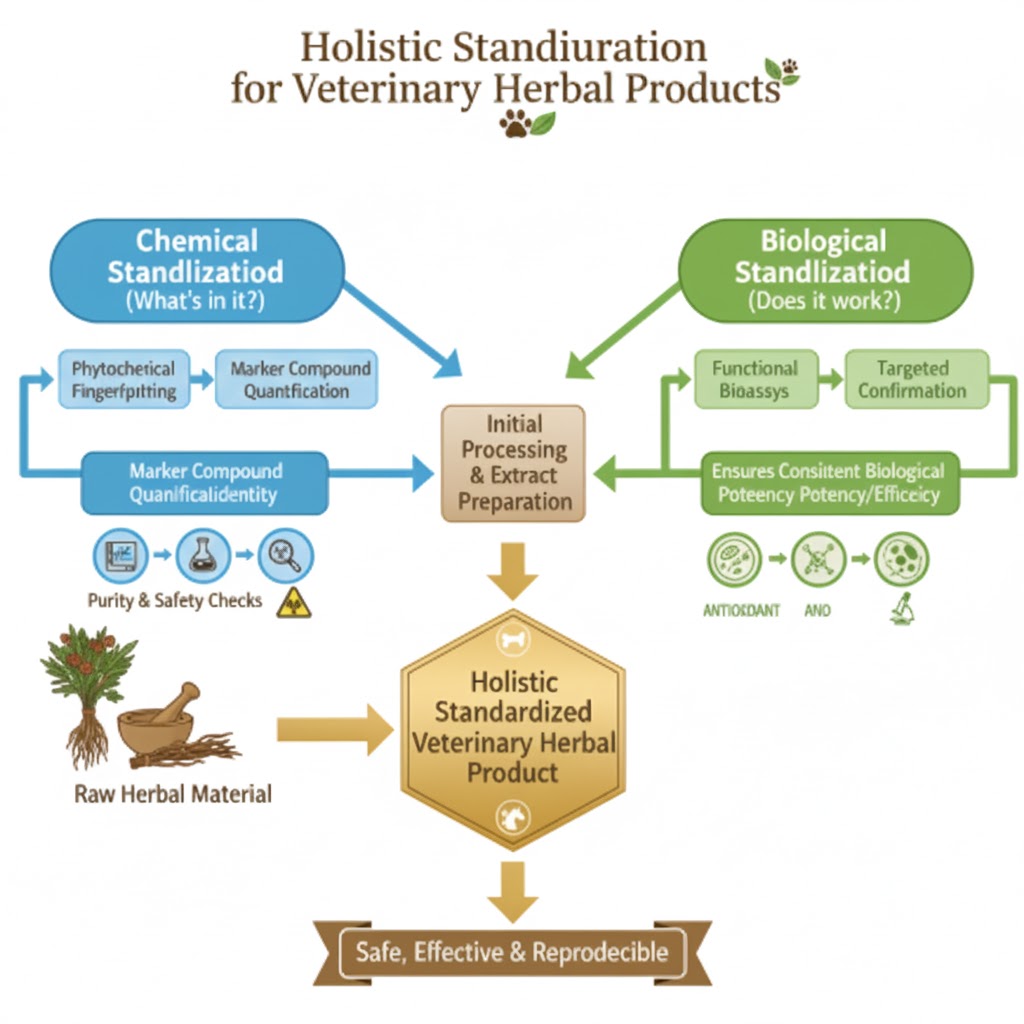
The final dosage form before release has to be checked for stability test determinations (shelf life) and disintegration/dissolution time within a time frame appropriate for the absorption pathway of the target animal (Kim et al., 2019). By compelling GMP, herbal veterinary products manufacturers build up their credibility and provide the assurance necessary that the final formulation is safe, effective, and reproducible for use in animal health (Wang et al., 2023).
Phytochemical fingerprinting gives a unique profile of the chemical composition of the herbal extract. Major constituents’ identification and quantitation can be carried out using techniques such as HPLC, GC, and LC-MS. The marker compounds serve as quality indicators either because they are responsible for pharmacological activity or because they represent the chemical integrity of the extract (Rastogi et al., 2015). For example, Curcuma longa (Turmeric) contains curcumin, and Neem contains azadirachtin, which act as standard markers (Table 3). Such standardization ensures batch-to-batch consistency and predictable therapeutic results (Guo et al., 2016, Rastogi et al., 2015).
| Herb | Marker Compound | Therapeutic Function |
|---|---|---|
| Azadirachta indica (Neem) | Azadirachtin | Antiparasitic, insecticidal, antibacterial |
| Curcuma longa (Turmeric) | Curcumin | Anti-inflammatory, antioxidant, hepatoprotective |
| Withaniasomnifera (Ashwagandha) | Withanolides | Adaptogenic, stress-reducing, immunostimulant |
| Glycyrrhiza glabra (Licorice) | Glycyrrhizin | Anti-inflammatory, antiviral, expectorant |
| Phyllanthus emblica (Amla) | Ascorbic acid, ellagic acid | Antioxidant, hepatoprotective, rejuvenative |
The principles of biological standardization and functional bioassays are even more important in veterinary medicine, where different species (e.g., dog, cat, horse, livestock) exhibit different types of metabolisms, sensitivities, and toxicological profiles (Kuralkar & Kuralkar, 2021).
THE CHALLENGE OF VETERINARY APPLICATION
The herbal products possess complicated criteria, unlike synthetic drugs, which include ancient veterinary formulas (like those used in Traditional Chinese Ayurveda or Veterinary Medicine) that are polyherbal (multi-ingredient) (Rastogi et al., 2015). The final effect is not just the sum of individual parts, but it is a synergistic effect. Bioassay can confirm the total synergistic activity (Table 4), but chemical analysis can quantify the markers (Zhou et al., 2016; Wagner & Ulrich-Merzenich, 2009). An herb that is an effective anti-inflammatory in a horse may have no effect or be toxic in a cat because, for example, the glucuronidation capacity is poor in felines. The bioassay assures that activity is present in the targeted biological system. For many botanicals, the exact "active" agent providing the therapeutic effect in animals remains unknown. Standardization on a chemical marker substance alone is insufficient if the marker is not the primary compound providing the desired effect.
Biological standardization provides a finished herbal veterinary product with a reproducible and quantifiable biological effect that should correspond to a therapeutic claim, wherever minor batch-to-batch chemical variations are present. In a nutshell, it answers: “Does the product have the same biological 'power' every time we make it?” (Mane et al., 2025). Bioassays are usually performed in vitro to assay a drug's interaction with a specific biological target that has some relevance to the animal's health. The Summary of the bioassays is mentioned in Table 4.
REGULATORY OVERSIGHT AND PHARMACOVIGILANCE
Herbal veterinary medicines are considered in an important regulatory framework, but are quite complicated and have divided positions between the traditional remedy and modern pharmaceutical worlds. This mainly strives to ensure its safety, quality, and efficacy after the product has been marketed (Vidhamaly et al., 2022). Herbal veterinary medicines fall under inconsistent oversight due to their inherently complex, multi-compound nature. They do not fall distinctly under one category, such as a single-compound prescription drug or a simple feed additive. They may be regulated either as traditional herbal products (have a simplified registration considering traditional use but often with limited claims) or as feed supplements, which are less strictly regulated (primarily for safety and contaminants, not for therapeutic efficacy) (Khoobchandani, 2024).
There is much variation in standards from country to country. To address this variation, global initiatives by international organizations such as the WHO and OIE support the creation and use of unified standards and guidelines, such as GACP and GMP, respectively, on quality and manufacturing. Veterinarians are the cornerstone of the function of a pharmacovigilance system for animal products. It shall be the responsibility of every Veterinarian to report any suspected adverse reactions (unexpected illness, toxicity, or death) related to a herbal product to a proper national regulatory body like the FDA in the US or EMA in the EU (Bent & Ko, 2004). There is a special and important safety issue in the food animal species, which is residue (presence of an herbal compound or its metabolites in animal products, e.g., meat, milk, egg) and withdrawal period (the time elapsed following the last application of a product before the sale of an animal or its products for human consumption). Veterinarians should utilize only those products that have a known, safe withdrawal period or provide the client with the appropriate holding times. The therapeutic use of a herbal must not compromise human food safety (Vidhamaly et al., 2022).
Continuous quality improvement and regulatory updates are really driven by post-market surveillance. If pharmacovigilance reports consistently point out an issue with a certain herb, for example, toxicity in felines, regulators require more rigorous testing for contaminants or species-specific bioassays and amend standards. Warnings or contraindications are to be mentioned on the package and removal from the market, unsafe or chronically ineffective products (Vidhamaly et al., 2022).
PHARMACOVIGILANCE: ENSURING SAFETY AFTER AUTHORIZATION
Pharmacovigilance refers to the science and activity relating to the detection, assessment, understanding, and prevention of adverse effects or any other drug-related problems after the product has been approved and is on the market. In the context of herbal veterinary products, pharmacovigilance is particularly important. A notable example was the use of herbal preparations such as Neoplasene derived from bloodroot (Sanguinaria canadensis) in dogs. Neoplasene was marketed as a remedy for skin cancers in pet animals and has been linked with prominent tissue injury and inflammatory reactions. There is a reported case that after intratumoral injection of a bloodroot extract in two dogs, severe necrosis and inflammation in the tissues removed were registered. One animal needed extended postsurgical care and showed considerable tissue reactions that surpassed therapeutic assumptions. This case points to the inconsistent pharmacological and toxicological side effects of some herbal veterinary agents and stresses the requirement for pharmacovigilance systems that apprehend unforeseen detrimental results in actual situations.(Childress et al., 2011).
| Bioassay Type | Therapeutic Claim | What the Assay Measures | Veterinary Relevance | References | |
|---|---|---|---|---|---|
| Antimicrobial Sensitivity Tests | Treatment of bacterial infections (e.g., skin, gut). | The extract's ability to inhibit the growth of specific pathogenic bacteria (e.g., Staphylococcus or E. coli) collected from veterinary sources. | Crucial for products positioning themselves as alternatives to antibiotics in livestock or pets. | Shin & Park, 2018 | |
| Enzyme Inhibition Assays | Anti-inflammatory action, joint support. | The product's capacity to inhibit enzymes like COX-2 or 5-LOX, which are key mediators in the inflammatory cascade in mammals. | Standard for herbal supplements targeting equine or canine joint mobility/arthritis. | Dinarello, 2010 | |
| Antioxidant Assays | Immune support, geriatric health, athletic performance. | The ability of the extract to neutralize free radicals (e.g., DPPH, ORAC assays) or protect cells from oxidative stress. | Important for high-performance animals (horses, working dogs) or senior pets where oxidative damage is high. | Prior et al., 2005 | |
| Cytotoxicity/Cell Viability Assays | Cancer support, safety profile. | The concentration of the extract required to kill abnormal cells (e.g., cancer cell lines) while sparing normal, healthy cells. | Required for safety and preliminary efficacy screening of any product used in oncology protocols. | Vail et al., 2019 |
Essential oils have also been implicated in clinically important side effects in animals, though they are often hyped for their natural antimicrobial and insect repellent properties. A retroactive series of cases conducted using data from the ASPCA Animal Poison Control Center analysed 443 events of toxicosis in dogs and cats over a decade due to concentrated tea tree oil (Melaleuca alternifolia). Application of 100% tea tree oil, deliberately or inadvertently, gave rise to depression of the central nervous system, ataxia, tremors, lethargy, paresis, and other systemic symptoms. Higher prevalence of severe illness was observed in younger cats, showing vulnerability and toxicity patterns specific to certain species that are often missed when herbal products are used without veterinary supervision. These discoveries show that a well-known plant based products, which is recognized by many owners as benign, can produce serious unwanted effects and therefore warns for vigorous checking through validated pharmacovigilance structures (Khan et al., 2014).
Adverse effects that are induced by herbs are not restricted to isolated acute toxicoses; they often exhibit as fine signs that are unapparent without active monitoring. Phototherapeutic approaches, for example, which are used in canine pediatrics, have called for attention to the scarce data available on the effectiveness and performance of many botanical cures. Even widely used herbs, in this framework, can cause effects that complicate clinical results, especially when used in combination with conventional drugs. The literature highlights that the idea that what is natural is safe is a myth and it endangers animals because owners may avoid guidelines from professionals that lead to overlooked interactions and adverse events. In these contexts, reported harmful effects include hepatotoxicity, gastrointestinal disturbances, or changes in metabolism and elimination of the drug, specifically in unsafe populations like puppies or animals with jeopardized organ function (Quintavalla, 2024). In the literature, the lack of reporting of current cases and the requirement for structured pharmacovigilance systems for herbal veterinary products have been described as a critical gap. Conventional pharmacovigilance systems were designed for synthetic drugs and are not applied in a similar pattern effectively to herbal medicines. This presents unique challenges such as complex profiles of constituents, variation in the quality of raw material and inconsistent manufacturing processes. Additionally, adverse effects from herbal products are often miscredited to the underlying condition due to insufficient or incomplete reporting or absence of intuition for toxicity related to the herb, further plummeting the standard of safety data. Present-day reviews on herbal drug pharmacovigilance emphasize the significance of increasing harmful effect reporting systems and coordinating tools for definitions and causality assessment to better apprehend and evaluate adverse reactions (Shetti et al., 2011).
From documented cases and pharmacovigilance analyses, one of the clear lessons learned is that active surveillance is necessary, not passive expectation that adverse events will be reported on their own accord. On the subject of herbal use for animal healthcare, which includes veterinarians, authorities for animal health and owners, must be involved in the collection of data and documentation of negative outcomes intentionally. Tools like standardized forms to report cases, compulsory requirements for reporting of serious events and amalgamation with existing systems for veterinary drug safety can assist in ensuring that actionable safety signals are identified early. Moreover, education campaigns for veterinarians and animal owners can upgrade understanding of adverse effects that may be related to herbs, preventing the deeply established prejudice that herbal products, due to their natural origins, are inherently safe (Bhat & Malik, 2022).
Ultimately, evidence from the case study also points to the significance of quality control and standardization of the product in minimizing unwanted reactions. Many adverse reactions occur from contamination, adulteration, mislabeling, or variation in active compound concentrations, issues aggravated by insufficient regulatory supervision. When herbal products are produced in the absence of consistent analytical validation, such as accurate profiling of constituents and screening for contamination, variability in clinical outcomes, and thus unpredictable adverse effects, becomes unavoidable. To deal with this, well-coordinated international guidelines on herbal pharmacovigilance, together with strict quality assurance practices from cultivation to distribution, are crucial for safeguarding animal health. Contemporary case data on adverse effects not only serve to highlight specific clinical risks but also to account for systemic development that can avert harm (Organization, 2004).
CONCLUSION
Herbal veterinary medicines have the potential to supplement conventional therapy, provided they are standardized, authenticated, and manufactured under GMP. From cultivation to clinical application, quality control secures both therapeutic efficacy and safety. Veterinary professionals should demand traceability, transparency, and validated analytical data for every product they endorse.
References
- Bent S & KO R, 2004. Commonly used herbal medicines in the United States: a review. American Journal of Medicine 116:478-85.
- Bhat MDA & R Malik, 2022. Challenges in monitoring the safety of herbal medicines-an appraisal. Journal of Pharmacovigilance and Drug Research 3:3-8.
- Childress MO, RC Burgess, CH Holland et al., 2011. Consequences of intratumoral injection of a herbal preparation containing blood root (Sanguinaria canadensis) extract in two dogs. Journal of the American Veterinary Medical Association 239:374-9.
- Dinarello CA, 2010. Anti-inflammatory agents: present and future. Cell 140:935-50.
- Govindaraghavan S & NJ Sucher, 2015. Quality assessment of medicinal herbs and their extracts: criteria and prerequisites for consistent safety and efficacy of herbal medicines. Epilepsy and Behavior 52:363-71.
- Guo L, L Duan, LL Dou et al., 2016. Quality standardization of herbal medicines using effective compounds combination as labeled constituents. Journal of Pharmaceutical and Biomedical Analysis 129:320-31.
- Hasan MM, MM Rahman, MR Islam et al., 2017. A key approach on dissolution of pharmaceutical dosage forms. Pharma Innovation Journal 6:168-80.
- Khan SA, MK Mclean & MR Slater, 2014. Concentrated tea tree oil toxicosis in dogs and cats: 443 cases (2002–2012). Journal of the American Veterinary Medical Association 244:95-9.
- Khanal C, S Swar & U Tandulkar, 2018. Handbook of pharmacognosy. Natural Product Research Laboratory, Kathmandu, Nepal.
- Khoobchandani M, 2024. Unveiling the complexity of herbal medicine: safety, toxicity and regulatory challenges. In: Medicinal Applications of Phytopharmaceuticals. Springer Nature Switzerland, Cham, pp:269-82.
- Kim JH, K Lee, UM Jerng et al., 2019. Global comparison of stability testing parameters and testing methods for finished herbal products. Evidence Based Complementary and Alternative Medicine 2019:7348929.
- Kosalec I, J Cvek & S Tomic, 2009. Contaminants of medicinal herbs and herbal products. Arhiv za Higijenu Rada i Toksikologiju 60:485.
- Kuralkar P & S Kuralkar, 2021. Role of herbal products in animal production–An updated review. Journal of Ethnopharmacology 278:114246.
- Lai XW, DL Sun, CQ Ruan et al., 2014. Rapid analysis of aflatoxins B1, B2 and ochratoxin A in rice samples using dispersive liquid–liquid microextraction combined with HPLC. Journal of Separation Science 37:92-8.
- Mane D, G Bawsiwal, Y Girbane et al., 2025. Isolation, purification and characterization of bioactive compounds from advanced herbal technology. Journal of Advance and Future Research 3:146-63.
- Mpanyakavili A, C Mwankuna, F Mabiki et al., 2022. LC–MS/MS method for determination of non-opioid analgesics adulterants in herbal medicines. Chemistry Africa 5:2149-62.
- Noviana E, G Indrayanto & A Rohman, 2022. Advances in fingerprint analysis for standardization and quality control of herbal medicines. Frontiers in Pharmacology 13:853023.
- Organization WH, 1998. Quality control methods for medicinal plant materials. World Health Organization.
- Organization WH, 2003. WHO guidelines on good agricultural and collection practices for medicinal plants. World Health Organization.
- Organization WH, 2004. WHO guidelines on safety monitoring of herbal medicines in pharmacovigilance systems. World Health Organization.
- Organization WH, 2011. Quality control methods for herbal materials. World Health Organization.
- Pallarés N, H Berrada, G Font et al., 2022. Mycotoxins occurrence in medicinal herbs dietary supplements and exposure assessment. Journal of Food Science and Technology 59:2830-41.
- Prior RL, X Wu & K Schach, 2005. Standardized methods for the determination of antioxidant capacity and phenolics in foods and dietary supplements. Journal of Agricultural and Food Chemistry 53:4290-302.
- Quintavalla F, 2024. Phytotherapeutic approaches in canine pediatrics. Veterinary Sciences 11:133.
- Rastogi S, MK Pandey, J Prakash et al., 2015. Veterinary herbal medicines in India. Pharmacognosy Reviews 9:155.
- Sahare AY, SC Akare, RB Agrawal et al., 2025. Standardization and quality control of Ayurvedic polyherbal formulations. International Journal of Pharmacognosy and Herbal Drug Technology 7:103-20.
- Shchukin V, E Zhigilei, A Erina et al., 2020. Validation of an ICP-MS method for the determination of mercury, lead, cadmium and arsenic in medicinal plants and related drug preparations. Pharmaceutical Chemistry Journal 54:968-76.
- Shetti S, CD Kumar, NK Sriwastava et al., 2011. Pharmacovigilance of herbal medicines: current state and future directions. Pharmacognosy Magazine 7:69.
- Shin B & W Park, 2018. Zoonotic diseases and phytochemical medicines for microbial infections in veterinary science: current state and future perspective. Frontiers in Veterinary Science 5:166.
- Singh PA & A Baldi, 2018. Good agricultural practices: a prerequisite approach for enhancing the quality of Indian herbal medicines. Biomed Journal 2:4.
- Techen N, I Parveen, Z Pand et al., 2014. DNA barcoding of medicinal plant material for identification. Current Opinion in Biotechnology 25:103-10.
- Vail DM, DH Thamm & JM Liptak, 2019. Withrow and MacEwen's small animal clinical oncology. Elsevier Health Sciences.
- Vidhamaly V, K Bellingham, PN Newton et al., 2022. The quality of veterinary medicines and their implications for One Health. BMJ Global Health 7:008564.
- Wagner H & G Ulrich-Merzenich, 2009. Synergy research: approaching a new generation of phytopharmaceuticals. Phytomedicine 16:97-110.
- Wang H, Y Chen, L Wang et al., 2023. Advancing herbal medicine: enhancing product quality and safety through robust quality control practices. Frontiers in Pharmacology 14:1265178.
- Wondimu KT & AK Geletu, 2023. Residue analysis of selected organophosphorus and organochlorine pesticides in commercial tomato fruits by gas chromatography mass spectrometry. Heliyon 9:14121.
- Xie P, S Chen, YZ Liang et al., 2006. Chromatographic fingerprint analysis—a rational approach for quality assessment of traditional Chinese herbal medicine. Journal of Chromatography A 1112:171-80.
- Zhang J, B Wider, H Shang et al., 2012. Quality of herbal medicines: challenges and solutions. Complementary Therapies in Medicine 20:100-6.
- Zhou X, SW Seto, D Chang et al., 2016. Synergistic effects of Chinese herbal medicine: a comprehensive review of methodology and current research. Frontiers in Pharmacology 7:201.