
INTRODUCTION
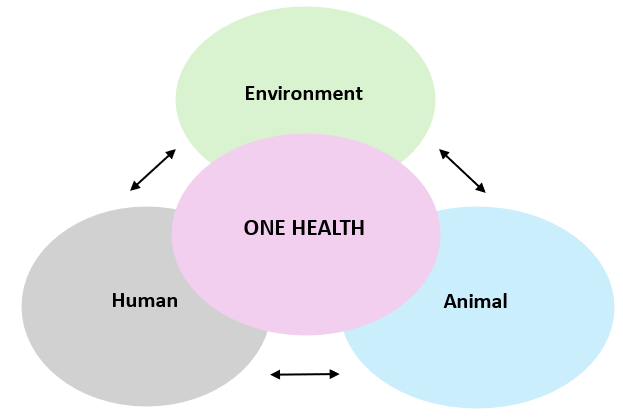
In the 21st century, significant changes have occurred in how human beings interact with wildlife and ecosystems. The clear boundaries between species and environments are fading due to globalization, rapid urbanization, climate variability, and the intensification of agricultural practices. The One Health approach is a vital model that highlights the interconnectedness of human, animal, and environmental health for the survival of well-being (Fig. 1). One Health is a vital tool for addressing the global health challenges we face (Zinsstag et al., 2015). One Health originated in the nineteenth century. The pathologist Rudolf Virchow (German), also known as the father of pathology, famously stated that “between animal and human medicine there are no dividing lines, nor should there be.” His work on zoonotic infections revealed the importance of human, animal, and environmental connections. William Osler (founding figure in modern medicine) highlighted the importance of veterinary sciences in Public Health. But due to limited collaborations between Public Health and Veterinary Sciences, we have not achieved the goals of equity yet (Sundberg & Schofield, 2009).
With the recognition of emerging infectious diseases (EIDs) in the late twentieth and early twenty-first centuries, that the urged the union. Outbreaks of severe acute respiratory syndrome (SARS) in 2002–2003, avian influenza H5N1, and Ebola virus disease have shown how ecological and socio-political factors play an important role in zoonoses (Gibbs, 2014). The economic cost of COVID-19 was estimated in the trillions of dollars, which was beyond the GDP of many developing countries, which revealed how global stability and prosperity are deeply tied to Health (El Zowalaty & Jarhult, 2020). One Health extends well beyond zoonoses; the One Health model deals with antimicrobial resistance (AMR), food security and safety, climate change, and environmental degradation as well. More than 60 percent of emerging human diseases are zoonotic and 70 percent of them come from animals. Excessive use of antibiotics in the agricultural sector has created ecological niches for antimicrobial-resistant bacteria, which in turn has spread AMR in soil, water, and food systems (Jones et al., 2008).
One Health provides a real-time framework for the social, political, and ecological determinants of health. It resonates with Planetary Health (the impact of human activity on the Earth’s natural systems), and the Sustainable Development Goals (SDGs), which link health to sustainability. One Health centers on practical collaboration across multiple sectors, which makes it directly applicable to surveillance systems, policymaking, and field interventions (Pulliam et al., 2012). The Quadripartite Alliance {World Health Organization (WHO), the Food and Agriculture Organization of the United Nations (FAO), the World Organisation for Animal Health (WOAH), and the United Nations Environment Programme (UNEP)} has institutionalized One Health at the global level through the Joint Plan of Action. Countries such as Rwanda, Thailand, and the United States are using national One Health platforms for zoonotic disease surveillance and AMR control. Such Initiatives visibly underline the importance of interconnectedness of humans, animals and ecosystems for human survival.
FOUNDATIONS OF ONE HEALTH
Human, Animal and Environmental Health Connection
One Health puts emphasis on the fact that human health cannot be separated from the health of animals and ecosystems. This relationship is empirically demonstrated through epidemiological data, ecological studies, and molecular biology. Ecological disruptions (deforestation, agricultural intensification, wildlife trade, and climate variability) play a significant role in human health and in reshaping the variability of a pathogen (Jones et al., 2008). For example, deforestation in South America has reshaped the mosquito breeding patterns, due to which the transmission of malaria was rapid even in the areas with low risk (Yasuoka & Levins, 2007). In Southeast Asia, the palm oil plantations disrupted bat habitats, forcing them to live near human populations and domestic animals. This ecological shift caused the Nipah virus breakout, which spread from fruit bats to pigs and subsequently to humans (Pulliam et al., 2012).
Antimicrobial resistance has become one of the most pressing matters of world. Antibiotics used in livestock farming often leach into soil and water systems, creating reservoirs of resistance genes. These resistant strains can circulate across species and ecosystems, making AMR an unavoidable challenge in One Health. Thus, the boundaries that once separated human, animal, and environmental health are nearly gone, which calls for holistic health approaches (Robinson et al., 2016).
Holistic Health Approaches
One Health acknowledges the complexity, feedback loops, and emergent traits of health dynamics. Traditional biomedical approaches often rely on theories that focus on individual hosts or specific pathogens, but One Health puts focus on all the factors that can cause a certain disease. For example, a zoonotic outbreak occurs due to cultural practices, governance structures, economic conditions, and biodiversity loss and climate change rather than solely by disease transmission (Pit & Gunn, 2024). Holistic One Health approaches advocate the preliminary precautions rather than the reactive approach when an outbreak occurs, such as wildlife surveillance, ecosystem management, and land-use policies that reduce risks. In Uganda, gorilla tourism is monitored through health protocols for both animals and humans, reducing the chances of disease exchange. In East Africa, meteorological and environmental data are used to predict Rift Valley fever outbreaks and provide vaccinations to livestock before the occurrence of the disease (Anyamba et al., 2012).
Principles and Values
The One Health framework is guided by principles that extend beyond technical collaboration. These include collaboration, equity, prevention, sustainability and trans-disciplinarity. An effective One Health model needs multisectoral and multidisciplinary collaboration. Epidemiologists, public health practitioners, ecologists, economists, and policymakers can work together to achieve better results. One Health puts emphasis on the human, animal and environmental health, which makes it an equitable approach. It also provides socio-economic solutions for vulnerable populations. One Health deals with preventive measures rather than an active outbreak. It focuses on reducing deforestation, better surveillance systems and vaccination approaches. One Health Techniques aligns with the United Nations Sustainable Development Goals (SDGs). Trans-disciplinarity means that the local community is aligned and connected with policymakers, ensuring that One Health interventions are context-sensitive and locally owned (Danasekaran, 2024).
Institutional and Policy Support
The formation of the Quadripartite Alliance (WHO, FAO, WOAH, UNEP) has made One Health accepted at the global level. The Quadripartite Joint Action (2022–2026) provides a roadmap for integrating surveillance, governance, and capacity building. At the national level, countries are acting. The United States established the One Health Office within the Centre for Disease Control and Prevention (CDC), which works on AMR and zoonotic diseases. Rwanda is using a One Health Strategic Plan through which the ministries of health, agriculture, and environment work together; it is one of the most advanced models in sub-Saharan Africa (Carroll et al., 2021). International initiatives such as the Global Virome Project are working on the mapping of viruses that affect wildlife. Similarly, the European One Health Action Plan against AMR has integrated the veterinary, human, and environmental surveillance into a unified action.
Comparison With Related Frameworks
One Health often overlaps with Planetary Health and Eco Health. EcoHealth is defined as the role of the ecosystem in nurturing human health, with a focus on biodiversity aid. Planetary Health concentrates on sustainability, ecology and climate. One Health is a practical collaboration across sectors to address specific challenges like zoonoses, AMR, and food safety.
Ethical Dimensions of One Health
Even though one health is a scientific paradigm, it also raises ethical queries, such as whether culling of wildlife during a zoonotic outbreak can save humans, but it also endangers biodiversity. Ethical considerations should be followed when dealing with animal health, research and experimentation. Environmental health also falls under One Health ethical considerations, as the environment is the natural habitat of animals. Ethical One Health interventions create a balance between human and wildlife. The principle of One Welfare is that animal welfare, social justice, and environmental health are mutually important (Van Herten et al., 2019).
Embedding One Health into education is crucial now. Universities such as the University of Global Health Equity in Rwanda and the University of California, Davis have developed training interconnected medical, veterinary, and environmental sciences programs. These programs aim to produce professionals with multidisciplinary knowledge that will allow them to work efficiently. Training professionals with broad expertise is vital since it reduces the workload and number of staff allocated to a single activity (Rabinowitz et al., 2017).
GLOBAL HEALTH CHALLENGES AND THE NEED FOR ONE HEALTH
The following are the global health challenges that require the One Health approach;
Zoonotic diseases: transmission of zoonotic diseases is a global health threat, accounting for most recent pandemics. From HIV/AIDS to SARS, Middle East Respiratory Syndrome (MERS), Ebola, and COVID-19, zoonotic pathogens have shown their great capacity to destroy economies and societies (Pigott et al., 2014; Webster, 2020).
Origins and drivers: deforestation, fragmentation of habitats, and bringing wildlife into closer proximity with humans and domestic animals increase the spread of pathogens. The boundary between human and animal habitats is becoming increasingly blurred due to overpopulation and changes in lifestyle, which has raised the risk of zoonotic illnesses. Animals are now closer to humans as a result of habitat destruction. For example, Ebola outbreaks in Central Africa are linked with the hunting of bush meat, which brought humans into closer contact with fruit bats (suspected reservoir host) (Rulli et al., 2017)
Global impacts and regional dimensions: A report given by World Bank in 2022, COVID-19 caused millions of deaths as well as great economic loss ($12.5 trillion) by disrupting global trade, education and healthcare systems. Spending on ecological and wildlife surveillance would have cost half. The lesson we get is that spending on surveillance and pandemic preparedness could save us from enormous global risks in both health and economy. Sub-Saharan Africa and South Asia have been identified as focal points of emerging diseases due to high biodiversity, rapid land-use change, and dense human populations (Jones et al., 2008). But high-income countries are not secure as well; the spread of Lyme disease in North America and the transmission of ticks have increased due to climate change (Eisen & Eisen, 2018).
Antimicrobial resistance (AMR): AMR is a quintessential One Health issue, as resistant microbes traverse humans, animals, and the environment. Misuse and overuse of antibiotics in medicine and agriculture accelerate the evolution of resistant strains, which spread across sectors through food chains, water systems, and direct contact.According to the World Health Organization, AMR already causes an estimated 1.27 million deaths annually, with nearly 5 million deaths associated with resistant infections (Murray et al., 2022). Without effective control, AMR could cause 10 million deaths annually by 2050 and inflict cumulative economic losses of USD 100 trillion.
Agricultural and environmental dimensions: In livestock production, antibiotics are often used not only for therapeutic purposes but also as growth promoters. Residues of these antimicrobials enter the environment through manure and wastewater, creating reservoirs of resistance genes. Resistant bacteria can then colonize humans through direct contact or food consumption. For instance, extended-spectrum beta-lactamase (ESBL)-producing E. Coli have been detected in both poultry and human populations, illustrating cross-sectoral transmission. Pharmaceutical effluents and agricultural runoff introduce antimicrobial residues into soil and water, where resistance genes can proliferate and persist. Aquaculture systems, particularly in Asia, have been hotspots for resistance gene transfer due to heavy antibiotic use (Robinson et al., 2016)
Policy responses: One Health frameworks have informed global and regional AMR action plans. The European Union’s ban on antibiotic growth promoters in livestock (2006) demonstrates policy-level progress. The European One Health Action Plan against AMR integrates human, veterinary, and environmental monitoring. Globally, the Quadripartite Alliance (WHO, FAO, WOAH, UNEP) has made AMR a central pillar of its Joint Plan of Action.
Food security and safety: The safety and availability of food are deeply intertwined with human, animal, and environmental health. Pathogens such as Salmonella, Campylobacter, and E. Coli illustrate how agricultural practices directly affect human health outcomes (Grace, 2015). According to WHO, Foodborne illnesses are diseases acquired by eating or drinking contaminated food or water that contains poisons, chemicals, parasites, or pathogenic microbes. Globally, foodborne diseases affect an estimated 600 million people annually, causing 420,000 deaths. These burdens fall disproportionately on children under five and populations in low and middle-income countries (LMICs). Contaminated animal products, unsafe irrigation water, and poor food handling practices are major contributors. The African swine fever outbreak (2018–2021) devastated pork production in China, leading to shortages and economic losses exceeding USD 100 billion. This event illustrates how animal disease outbreaks can destabilize food supply chains, impacting nutrition and livelihoods. Food supply chains are increasingly globalized, making foodborne risks transnational. A Salmonella outbreak in peanut butter in the United States, for instance, triggered recalls across multiple countries. These complexities highlight the necessity of integrated food safety systems (FAO, 2021)
Climate change: Climate change acts as a “threat multiplier,” exacerbating existing health vulnerabilities and creating new ones. Rising temperatures, shifting rainfall patterns, and extreme weather events reshape ecosystems, altering the distribution of disease vectors and pathogens (Campbell-Lendrum et al., 2015)
Vector-borne diseases: Mosquitoes, ticks, and other vectors are highly sensitive to climate conditions. Warmer temperatures and changing precipitation patterns are expanding the geographic range of diseases such as malaria, dengue, chikungunya, and Zika. For instance, Aedes aegypti, the primary vector for dengue and Zika, is projected to expand into temperate regions of Europe and North America (Ryan et al., 2019).
Water and food-borne diseases: Flooding and extreme rainfall increase waterborne diseases, e.g., cholera. Canned food, malnutrition, and excessive unhealthy eating cause food-borne diseases. One Health integrates ecological, agricultural, and health data, which helps in creating preventive measures. For instance, Rift Valley Fever was detected early using climate and meteorology, which led to early vaccination (Anyamba et al., 2012).
CASE STUDIES ILLUSTRATING ONE HEALTH IN ACTION
COVID-19 Pandemic
The COVID-19 pandemic is the latest outbreak that reminds us of the importance of One Health.SARS-CoV-2 had zoonotic roots, with bats serving as the likely reservoir. COVID-19 revealed serious weaknesses in global health governance. Delayed reporting, missing surveillance, and insufficient communication allowed the virus to spread unchecked (Andersen et al., 2020). COVID-19 taught us that integrating ecological surveillance with human health can help us identify such threats easily. This pandemic also showed the inequity in vaccine distribution, due to which the vulnerable population suffered more, a hole in health systems (Cassini et al., 2019).
Antimicrobial Resistance (AMR) in Europe
In 2006, the European Union put a ban on antibiotic growth promoters in livestock, which was followed by the European One Health Action Plan against AMR. Due to a ban on antibiotic growth promoters, antibiotic consumption by livestock has reduced, leading to less prevalence of methicillin-resistant bacteria staphylococcus aureus (MRSA) in animals. They shared data cross border that allowed the early detection of resistant strains. But still, due to inequity and health disparities, AMR is a global problem. For example, Southern and Eastern European nations report higher resistance rates compared to Northern Europe (EMA, 2020). This case study shows that policy and law enforcement can reduce the risks of certain health disparities. It also demonstrates how sharing data across borders can be helpful (Cassini et al., 2019).
Rift Valley Fever in East Africa
Rift Valley fever outbreaks affect livestock and humans simultaneously, causing economic losses and human morbidity. In the 2006–2008 outbreaks in East Africa, researchers used meteorological and remote-sensing data to predict RVF activity. These preliminary measures helped them significantly reduce human cases through mass vaccination. This case study demonstrates how One Health can move beyond active responses to sustained proactive prevention. The RVF case study also shows how early warning systems can reduce the load of disease. For these systems to be sustained, it requires a long-term economic and political commitment (Anyamba et al., 2012).
Rabies Elimination in Latin America
Rabies control in Latin America is one of the most successful One Health ventures. Doing community awareness campaigns and dog vaccination on a large scale reduced the rabies transmission. The veterinary and medicine sectors worked together to ensure both animal and human vaccination coverage. By the 2010s, human rabies cases in many Latin American countries had been reduced to near zero (Vargas-Pino et al., 2019). Rabies case study shows how a community can make an impact in achieving the best results. It also demonstrates how cost-effective solutions can yield high results, as the rabies dog vaccine is cheap.
Hendra virus in Australia
First identified in 1994 (Queensland, Australia), the Hendra virus was transmitted from fruit bats to horses, and subsequently to humans who were in close contact with infected horses. Urbanisation and deforestation eliminated the natural habitats of bats, driving them close to areas where horses and humans lived. Australian authorities used the One Health approach to reduce the risk. A horse vaccine was developed, significantly reducing transmission risk. The Hendra case study shows how the One Health approach can manage long-term risk reduction, combining local engagement, vaccination, and land-use strategies (Field, 2009).
Lyme disease in North America
Lyme disease, caused by Borrelia burgdorferi and transmitted by ticks, shows how climate change and biodiversity loss play an important role in human health. Due to a rise in temperatures and fragmentation of habitats, the range of ticks (Ixodes scapularis) that cause Lyme disease in North America. Control measures include integrated vector management, wildlife surveillance, and community education. Lyme disease conveys the necessity for long-term, adaptive strategies that control environmental and social drivers of disease emergence (Eisen & Eisen, 2018).
Cholera in Yemen
Cholera outbreaks in Yemen show how political instability integrates with environmental and health systems to create crises at such huge levels (the largest outbreak in modern history). Due to an ongoing conflict, the disruption of water and sanitation infrastructure happened that transmitted cholera. According to the UNICEF report, by 2020, more than 2.5 million suspected cases had been reported. The cholera outbreak in Yemen emphasises the significance of solid structures that incorporate infrastructure for water, sanitation, and healthcare. Additionally, it emphasises that One Health encompasses all situations where social and environmental factors lead to health emergencies, not just zoonoses. Cholera is not zoonotic, but its spread highlights the concepts of One Health by highlighting how political and environmental issues, such as water quality, influence health outcomes. It has been fundamental to have coordinated responses involving water management agencies, local health authorities, and humanitarian organisations.
BARRIERS AND LIMITATIONS
Institutional Silos and Funding Gaps
Most countries maintain separate ministries for health, agriculture, and the environment, which leads to fragmented responsibilities and weak coordination. Institutional bias and politics discourage healthy collaborations. For example, AMR surveillance is a social issue but is often taken as a medical, veterinary, or environmental risk (Okello et al., 2015). As per the World Bank, not many funds are provided to One Health initiatives, as targeting short-term specific is preferred as compared to systemic capacity building. For example, Ebola response funds in West Africa prioritise the short-term emergency containment rather than long-term wildlife or environmental surveillance.
Community Engagement and Global Inequities
Due to cultural norms and religious beliefs, many One Health programs do not get the required attention and engagement. For instance, resistance to bush meat bans in West Africa (Bonwitt et al., 2018). Low and middle-income countries (LMICs) bear burdens of zoonotic diseases and environmental changes, but due to limited resources, they cannot run One Health programs. Vulnerable population faces inequity that hiders in achieving One Health goals (Cleaveland et al., 2021).
Scientific and data gaps
There are large knowledge gaps despite the genomics and surveillance advances. Due to a lack of resources, many pathogenic diseases are not well-researched, that cause mass level destruction. Many potential zoonotic pathogens circulating in wildlife remain undiscovered. Due to political differences, security threats and intellectual rights, data sharing about zoonotic diseases is hindered (Carroll et al., 2021).
OPPORTUNITIES AND FUTURE DIRECTIONS
Enhanced Surveillance and Resilient Health Systems
Advances in satellite imagery and AI can create new opportunities for integrated disease surveillance. Systems such as the Global Early Warning System (GLEWS) is a best example for cross-sectoral monitoring. (Becker et al., 2020). One Health promotes integration of veterinary, environmental, and human health services. For example, joint training programs while sharing infrastructure (labs, supply chains) can create harmony and union among physicians and veterinarians. Embedding One Health in the syllabus is essential. Interdisciplinary training allows professionals to deal with health challenges. Community-level training ensures that locals are aware of surveillance and preventive techniques (Rabinowitz et al., 2017).
Global Governance and Integration with Sustainable Development
The Quadripartite Joint Plan of Action (2022–2026) is the best example of an international plan of action. Aligning national legislation with global commitments can harmonize preventive measures and reduce duplication. According to WHO, One Health aligns with SDGs, particularly with SDG 3 (Good Health and Well-being), SDG 6(Clean Water and Sanitation), SDG 13 (Climate action) and SDG 15 (Life on land). Integrating One Health into SDG monitoring frameworks can multiply co-benefits across health, environment, and equity. Zoonotic diseases, antibiotic resistance, food insecurity, climate change, and environmental degradation are just a few of the global health issues that cannot be sufficiently addressed by sectoral silos. A comprehensive framework to accomplish sustainable, equitable, and resilient development is provided through incorporating One Health into the SDGs.
PREPARING FOR FUTURE PANDEMICS
Early warning systems
Programs like GLEWS and the Global Virome Project are working on mapping pathogens early. Combining ecological, genomic, and climate data ensures the prediction of high-risk areas for different diseases (Carroll et al., 2021). Pandemic preparedness should include the health ministries, agriculture, wildlife, and environmental agencies. Multisectoral exercises and joint planning can improve coordination that will improve the overall dynamics of human and animal health. Public trust is very important when it comes to preventive measures. Misinformation during COVID-19 showed that transparent communication and local engagement are key to prevention. Using nationalistic approaches during COVID-19 caused an unequal distribution of the vaccine. Global solidarity in financing and resource distribution is required in the future (Yopa et al., 2023).
NEW THEMATIC DIMENSIONS
One Health should combine urban planning, sanitation, and housing policies for effective results. (Sharma et al., 2025). AI-driven surveillance can detect outbreaks earlier than traditional systems, so we need to work on AI to create equitable surveillance systems (Shaver, 2022). The World Bank (2017) estimated that AMR alone could cost USD 100 trillion by 2050. But investing in prevention will give great results. Prevention is more cost effective as compared to active outbreak treatment (Smith et al., 2019). Rotational grazing and reducing deforestation and growing more trees contribute to ecosystem health. One Health must integrate all these approaches to create a sustainable environment.
CONCLUSION
One Health shows the shift in global health systems. Through One Health, we get to know how human survival depends on balancing the ecological, social, political and international factors. One Health provides us solutions to AMR, food insecurity, environmental degradation, and climate change. There are a number of barriers that pose challenges, such as funding gaps, institutional bias, political agenda, etc. By using a one health approach, we can create a resilient, equitable and well-sustained society. Our task is to transform One Health into a fitting model that can be used as a norm across the globe. Human, animal and environmental collaboration are an integral part of better health security. A future with One Health is healthier, equitable and sustainable for all beings.
References
- Andersen KG, A Rambaut, WI Lipkin et al., 2020. The proximal origin of SARS-CoV-2. Nature Medicine 26:450-52.
- Anyamba A, KJ Linthicum, JL Small et al., 2012. Climate teleconnections and recent patterns of human and animal disease outbreaks. PLOS Neglected Tropical Diseases 4:611.
- Becker DJ, SN Seifert and CJ Carlson, 2020. Beyond infection: Integrating competence into reservoir host prediction. Trends in Ecology and Evolution 35:1062–73.
- Bedford J, J Farrar, C Ihekweazu et al., 2019. A new twenty-first century science for effective epidemic response. Nature 575:130–36.
- Bonwitt J, M Dawson, M Kandeh et al., 2018. Unintended consequences of the bush meat ban in West Africa during the 2013–2016 Ebola virus disease epidemic. Social Science and Medicine 200:166–73.
- Campbell-Lendrum D, L Manga, M Bagayoko et al., 2015. Climate change and vector-borne diseases: What are the implications for public health and policy? Philosophical Transactions of the Royal Society B: Biological Sciences370:20130552.
- Carroll D, P Daszak, ND Wolfe et al., 2021. The Global Virome Project. Science 359:872–74.
- Cassini A, LD Högberg, D Plachouras et al., 2019. Attributable deaths and disability-adjusted life-years caused by infections with antibiotic-resistant bacteria in the European Union and European Economic Area, 2015. The Lancet Infectious Diseases 19:56–66.
- Cleaveland S, J Sharp, B Abela-Ridder et al., 2021. One Health contributions to equity in low-income countries. Philosophical Transactions of the Royal Society B: Biological Sciences 376:20200168.
- Danasekaran R, 2024. One Health: A Holistic Approach to Tackling Global Health Issues. Indian journal of community medicine: official publication of Indian Association of Preventive and Social Medicine49:260–63.
- Eisen RJ & L Eisen, 2018. The blacklegged tick, Isoldes scapularis: An increasing public health concern. Trends in Parasitology 34:295-309.
- El Zowalaty, ME & JD Järhult 2020. From SARS to COVID-19: A previously unknown SARS-related coronavirus (SARS-CoV-2) of pandemic potential infecting humans–Call for a One Health approach. One health 9:100124.
- FAO (Food and Agriculture Organization), 2021. ASF situation update in African swine fever. Food and Agriculture Organization of the United Nations, Rome, Italy.
- Field H, 2009. Hendra virus ecology and surveillance. Microbiology Australia 30:90–93.
- Gibbs A, 2014. Contemporary American trauma narratives. Edinburgh University Press, Edinburgh, UK.
- Grace D, 2015. Food safety in low- and middle-income countries. International Journal of Environmental Research and Public Health 12:10490–507.
- Jones KE, NG Patel, MA Levy et al., 2008. Global trends in emerging infectious diseases. Nature 451:990-93.
- Murray CJL, KS Ikuta, F Sharara et al., 2022. Global burden of bacterial antimicrobial resistance in 2019: A systematic analysis. The Lancet 399:629-55.
- Okello AL, K Bardosh, J Smith et al., 2015. One Health in Africa: Past successes and future challenges. PLOS Neglected Tropical Diseases 9:0003893.
- Pit SJ & A Gunn, 2024. The One Health Concept. British journal of biomedical science 81:12366.
- Pulliam JRC, JH Epstein, J Dushoff et al., 2012. Agricultural intensification and Nipah virus emergence. Proceedings of the Royal Society B: Biological Sciences 279:4842-51.
- Rabinowitz PM, R Kock, M Kachani et al., 2017. Toward proof of concept of One Health. EcoHealth 14:4-9.
- Robinson TP, DP Bu, J Carrique-Mas et al., 2016.Antibiotic resistance as a One Health issue. Transactions of the Royal Society of Tropical Medicine and Hygiene 110:377-380.
- Rulli MC, M Santini, DT Hayman et al., 2017. The nexus between forest fragmentation in Africa and Ebola virus disease outbreaks. Scientific Reports 7:41613.
- Ryan SJ, CJ Carlson, EA Mordecai et al., 2019. Global expansion and redistribution of Aedes-borne virus transmission risk with climate change. PLOS Neglected Tropical Diseases 13:0007213.
- Sharma R, S Gupta, A Singh et al., 2025. Urbanization and emerging infectious diseases: A One Health perspective. Global Public Health 20:112-28.
- Shaver J, 2022. Artificial intelligence in global health surveillance. One Health 14:100370.
- Smith RD, MR Keogh-Brown, T Barnett et al., 2019. The economywide impact of pandemic influenza on the UK: a computable general equilibrium modelling experiment. Health Economics 28:843-57.
- Sundberg JP & PN Schofield, 2009. One medicine, one pathology, and the one health concept. Journal of the American Veterinary Medical Association 234:1530-1.
- Van Herten J, B Bovenkerk & M Verweij, 2019. One Health as a moral dilemma: Towards a socially responsible zoonotic disease control. Zoonoses and public health66:26-34.
- Vargas-Pino F, AI Garcia-Ramirez & DA Martinez-Bello, 2019. Achievements in rabies elimination in Mexico. Revista Panamericana de Salud Pública 43:17.
- Yasuoka J & R Levins, 2007. Impact of deforestation and agricultural development on anopheline ecology and malaria epidemiology. The American journal of tropical medicine and hygiene 76:450-60.
- Yopa DS, DM Massom, GM Kiki et al., 2023. Barriers and enablers to the implementation of one health strategies in developing countries: a systematic review. Frontiers in Public Health 11:1252428.
- Zinsstag J, D Waltner-Toews & M Tanner, 2015. One Health: the theory and practice of integrated health approaches. Theoretical Issues of One Health 28:16-25.