INTRODUCTION
Stem cells are unique cells that can self-renew and differentiate into more specialized cells (Poliwoda et al., 2022). In humans, these cells range from pluripotent, such as embryonic and induced pluripotent stem cells (iPSCs), which can differentiate into almost any type of tissue, to adult (tissue) stem cells, which are confined to maintaining specific organs such as blood, skin, and intestine. These greatly simplified explanations are why stem cells are important: they are nature's way to construct, sustain, and repair a body, and they also provide a fundamental method to study tissue formation and healing (Della Rocca et al., 2025).
Self-renewal denotes the ability of stem cells to produce new stem cells and thus, retain a stable pool over time, while differentiation implies that they can generate functionally specialized cells (for instance, red blood cells or neurons). In reality, a combination of the "niche", the signals that the neighboring cells and the environment provide, and the cell's own genetic architecture shapes these capabilities (Zakrzewsk et al., 2019). Current single-cell and "multi-omics" techniques have demonstrated that stem cells are not a single homogeneous population, but a continuum of states that can be modulated with development, injury, or disease. Such technologies enable scientists to map the RNA, chromatin, and other cellular layers and configurations of cells, thereby providing a far more detailed answer to the question of how fate choices are made (Wu et al., 2024).
Research-backed models indicate that pluripotent and adult stem cells can be cultivated into 3D 'organoids' (miniature tissue constructs that simulate and replicate the structure and functions of the gut, brain, lung, kidney, and liver) (Tang et al., 2022). The development of organoids has provided scientists with the ability to replicate human development and disease and test human therapeutics, as well as tailor medicines to an individual. Equally, organoids do overcome the limitations of studying simpler model organisms, cell cultures, or tissue (Liu et al., 2025). Recently developed fetal organoids, created from the ethically favorable amniotic fluid cells, hold the most substantial potential for studying and illuminating perinatal disorders as well as guiding perinatal therapeutics. Stem cells also continue to be an important component at the core of existing treatments, whereby HSCT (bone marrow transplant) has been largely used to treat blood cancers alongside other immune disorders for several decades, and gene-editing techniques in the clinic that seek to modify patients' stem cells from blood have now reached the point of care. Moreover, therapies developed from different types of stem cells are undergoing clinical trials worldwide (Bolideei et al., 2025).
During the late 20th century, various talks were illuminated in the mid-20th century about the human and mouse hematopoietic embryonic stem cells transplantation and blood formation using them, which served as the foundation for modern approaches in the field. The field witnessed a revolutionary mark with the development of iPSC technology, which allowed sophisticated dissection of disease mechanisms through patient-specific models, untethered to ethical constraints surrounding embryo generation and use (Boisset & Robin, 2012). The period since 2017 is remarkable for the way improvements, previously considered evolutionary, have been distilled to focus and streamline, to amass process spend visibility around more clinically relevant scientists' key progress: effective and clinically permissive closed system bioreactors. The integration of science and the strand of governance that oversees its application and development, has made considerable progress: in 2021 the International society of stem cell research (ISSCR), has put in place edicts that form the precursor of fames and boundaries around embryo-models, organoids, chimeras, genome alterations and applicable translations, in 2024-2025 ISSCR has clarified and complimented these for use in expatriate and supervisory embassies for these Innovation Service (Lovell-Badge et al., 2021).
Currently, the stem cell research field is applicable and rapidly evolving. Organoids are being engineered through microfluidics, gene editing, and bioprinting to serve as more accurate models for discovery and safety testing. Investigations on various potential uses for MSC (mesenchymal stromal cell) products continue (Galderisi et al., 2022); In hematology, HSCT continues as a mainstay while novel gene-edited autologous HSC therapies emerge for sickle-cell disease and thalassemia. At the same time, a global landscape analysis reported more than a hundred interventional trials of human-pluripotent-stem-cell-derived products through late 2024, especially involving eye and nervous-system disorders, indicating cautious laboratory-to-clinic translation (Kirkeby et al., 2025). All these stem cell interdependent components explain why stem cells are a focal point in biology courses, biomedical laboratories, and evidence-based translational scaffolds.
TYPE OF STEM CELL BASED ON DIFFERENTIATION METHOD
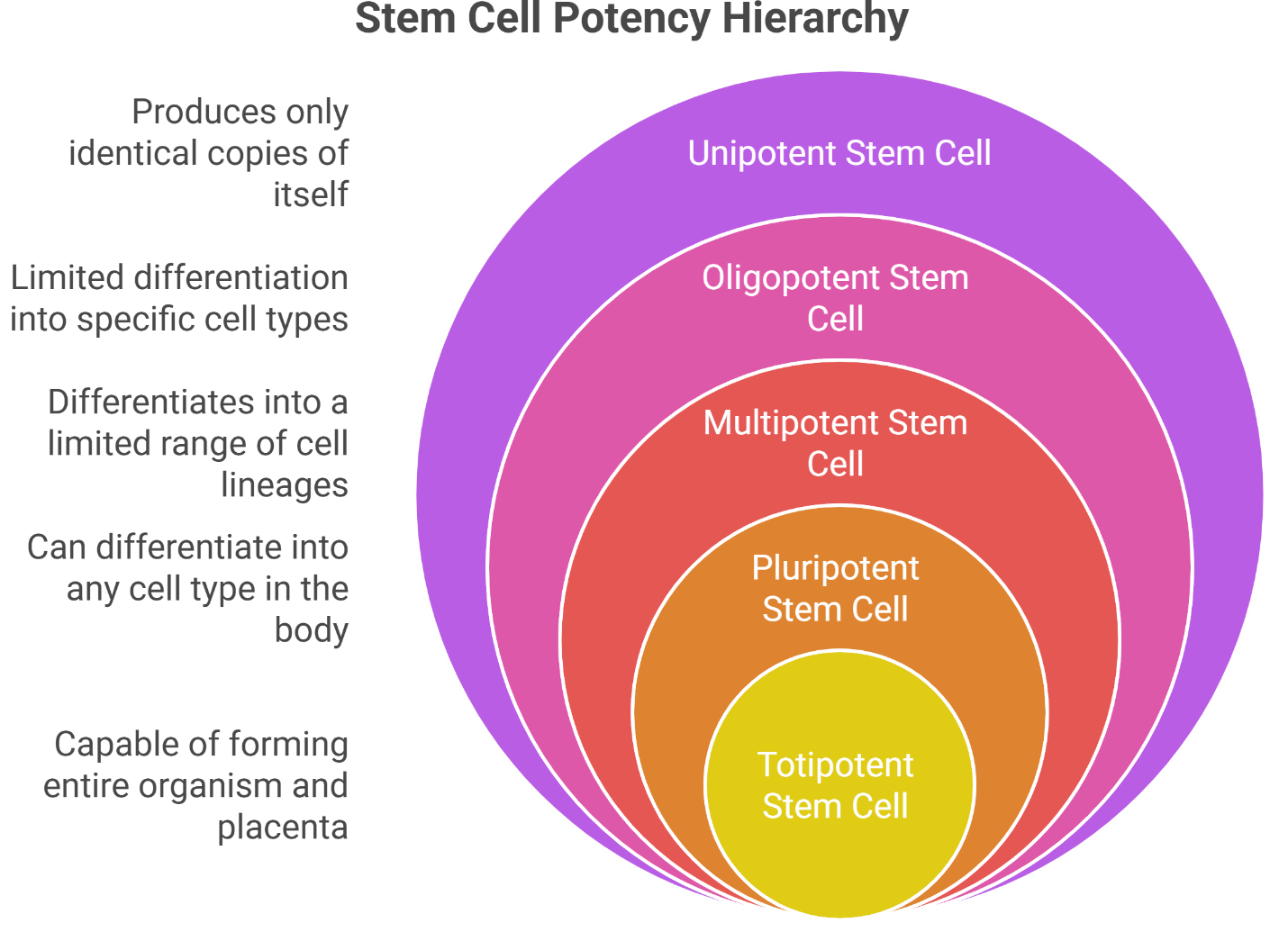
Totipotent Stem Cells
Totipotent stem cells have unrestricted developmental potential, meaning they can give rise to all embryonic and extra-embryonic tissues necessary for the complete development of the organism. They are present only in the earliest stages following fertilization and represent the most versatile stage of cellular differentiation. Their special ability to give rise to body and support structures makes them basic to the study of embryogenesis and developmental control in multicellular organisms ( Ghazimoradi et al., 2022).
Pluripotent Stem Cells
Pluripotent stem cells can make any cell that is derived from the three primary germ layers (ectoderm, mesoderm, and endoderm) but not extra-embryonic tissue. They have indefinite potential for self-renewal under appropriate culture conditions and are important models for investigating the genetic control of cell fate. Their balanced potential for renewal and specialisation is the foundation for modern regenerative biology and disease modelling across multiple species (Ávila-González et al., 2023).
Multipotent Stem Cells
Multipotent stem cells have a low potential and give rise to a limited number of closely related cell types within a particular tissue lineage. They make contributions to normal tissue maintenance, repair, and regeneration throughout life, whilst retaining the ability to self-renew. Controlled by their microenvironment/their niche, these cells respond to physiological cues that regulate activation, proliferation, and differentiation; this maintains the stability and function of mature organisms in the long term (Sobhani et al., 2017).
Oligopotent Stem Cells
Oligopotent stem cells can differentiate into a limited number of closely related cell lineages. Therefore, they fall in between an intermediate state between multipotent and unipotent states. They maintain specialized tissue compartments that must be renewed appropriately without excessive cell proliferation. The functional regulation of these requires well-coordinated signaling and transcriptional programs that assure lineage fidelity, but is limited in its adaptability to developmental or regenerative needs(Majo et al., 2008).
Unipotent Stem Cells
Unipotent stem cells are highly lineage-restricted, capable of making only one particular cell type and have the potential to self-renew (Fig. 1). In this function, they act as dedicated progenitors, ensuring continuous tissue replacement and repair within their defined domain. Although their potency is negligible, they are important for maintaining organ integrity; hence, we demonstrate that self-renewal can persist in terminally specialized biological systems (Quesenberry et al., 2022).
TYPE OF STEM CELL BASED ON ORIGIN
Embryonic Stem Cells
An embryonic stem cell is a pluripotent cell derived from the inner cell mass of the mammalian blastocyst. It can undergo unlimited self-renewal and differentiate into all somatic and germ-line cellular lineages. These are the earliest stages of development at which cell fate is still flexible and thus offer a model for studying embryogenesis in humans and animals, respectively (Park et al., 2024). In research, ESCs are irreplaceable for defining the signaling networks involved in development and for generating specific cell types in laboratories to study mechanisms of organ formation (Chen et al., 2022). They have also led to a greater understanding of the ethical boundaries in modern biology, which have encouraged detailed regulations worldwide regarding the use and laboratory manipulation of embryos. Overall, ESCs remain the yardstick by which other stem cell categories are measured because of their genetic stability, developmental range, and reproducibility across species (Park et al., 2024).
Somatic Stem Cells
Adult or somatic stem cells are multipotent stem cell progenitors found within specialized niches in tissues (after development has occurred in the organism). Unlike embryonic cells, they are lineage-restricted, since they preserve the tissues in which they reside; for instance, hematopoietic stem cells in bone marrow, epidermal stem cells in skin, intestinal crypt stem cells, or neural stem cells in the adult brain. Their function is to replace cells lost due to natural turnover or injury, thereby maintaining organ integrity throughout an organism's life. In mammals and many eukaryotic organisms, these cells are quiescent — resting—until they are stimulated by physiological demand. Key signaling pathways, such as Wnt, Notch, and bone morphogenetic protein (BMP) cascades, are important for controlling the balance between dormancy and differentiation. Due to their generally autologous nature, there are few immunologic and ethical issues involved with adult stem cells, which have been widely used in experimental regenerative schemes. System-wide, human and animal, they represent an example of how finite potency may be combined with lifelong self-maintenance, which is the biological basis for tissue repair and cellular homeostasis (de Morree & Rando, 2023).
Induced Pluripotent Stem Cells (iPSCs)
Somatic cells reprogrammed to the pluripotent state by regulated expression of specific transcription factors are called induced pluripotent stem cells. This discovery revolutionized the study of cell biology by demonstrating the conservation of entire genetic information in differentiated cells, enabling the restoration of developmental potential. Modern reprogramming methods have sought to investigate non-integrating or chemical approaches to make the process more efficient and safer, without compromising the genomic integrity of the reprogrammed cell. iPSCs share many biological and molecular properties with embryonic stem cells, but do not require the use of embryos, making them useful for research in human and veterinary settings. They have found broad use in modelling species-specific diseases, studies of processes during early development, and the genetic regulation of cell fate. Cross-species iPSC lines—from mice to livestock—have contributed to a deep understanding of the comparative developmental biology and evolutionary conservation of pluripotency networks. The technology has also led to the establishment of uniform cell banks, where various genetic backgrounds are recorded for use in global scientific collaboration (Guan et al., 2022).
Perinatal Stem Cells
Perinatal stem cells arise from tissues at the interface between the fetus and the mother and, as such, include umbilical cord blood, cord tissue, placenta, and amniotic fluid. They have characteristics that lie between embryonic and adult stem cells, combining broad differentiation potential with high proliferation/low immunogenicity. Collection is non-invasive and ethically low-key, and so such sources are becoming popular in developmental biology and translational science research. In humans, cord blood contains hematopoietic progenitors, and the surrounding tissues contain mesenchymal-like cells that can be differentiated into mesodermal, ectodermal, and endodermal cells under controlled conditions. Comparable populations of cells have been isolated from several animal species, thereby consolidating their biological relevance in mammals. Because perinatal tissues are routinely discarded after birth, they are a sustainable and reproducible source of stem cells that will be beneficial for in vitro modelling of developmental pathways and cross-species comparison of these developmental processes (Monti, 2021).
Cancer Stem Cells
Cancer stem cells are malignant mimics of normal stem cells that retain the capacity to self-renew and specialize but promote malignant growth rather than tissue maintenance. These constitute a small yet highly influential part of a tumor mass that drives clonal expansion, metastasis, and recurrence. CSC behavior is controlled by many of the same developmental signaling pathways that are active in healthy stem cells, such as Wnt/beta-catenin, Notch, and Hedgehog; however, in tumors, these pathways are activated in an uncontrolled manner, leading to uncontrolled proliferation. Evidence of CSC-like populations has been described in human and animal malignancies, suggesting stemness is a conserved feature of cancer biology. Their identification has paved the way for redefining the research perspective on tumor heterogeneity and drug resistance, as well as the continuum between normal regeneration and oncogenic transformation (Lathia & Liu, 2017). Research on CSCs continues to elucidate how dysregulation of developmental programs can drive regenerative potential toward disease, thereby establishing a direct link between stem-cell science and oncology (El-Tanani et al., 2025).
Mesenchymal Stem Cells
Mesenchymal stem cells are multipotent stromal cells that were originally found in bone marrow but are now known to be present in many other tissues, including adipose tissue, umbilical cord, placenta, dental pulp, and periosteum. They have a fibroblast-like morphology; they adhere to plastic in culture and, under defined conditions, give rise to mesodermal cell lines (osteoblasts, chondrocytes, and adipocytes). Beyond their ability to differentiate, MSCs also exert significant immunomodulatory and trophic effects by secreting cytokines, extracellular vesicles, and growth factors that interact with local cells and support tissue healing. In both the human and animal systems, MSCs respond dynamically to inflammatory cues. They are attracted to the injured site to participate in regeneration through paracrine signaling, rather than by replacing the injured tissue. Their relative ease of isolation, rapid ex vivo expansion, and low immunogenicity have made them the target of translational studies in disorders of the musculoskeletal, cardiovascular, and immune systems. However, variability between donors and culture conditions remains an obstacle to reproducibility, and at present, standardized potency assays and controlled bioprocessing are being developed to ensure reproducibility across species and laboratories (Lou et al., 2021).
Hematopoietic Stem Cells (Hscs)
Hematopoietic stem cells (HSCs) are mostly found in the bone-marrow niche of mammals. They are responsible for the lifelong renewal of all lineages of blood and immune cells. By definition, they are functions; that is, they have the capability of self-renewal and formation of the whole hematopoietic system when they are transplanted into a conditioned recipient. HSCs function in a highly specialized microenvironment, with stroma, endothelial, and osteoblastic cells providing cues for quiescence and lineage balance (Chen et al., 2024). Clinically, their biology underlies bone marrow and cord blood transplants. However, in a non-therapeutic setting, they represent a model for understanding stem cell hierarchies, the kinetics of self-renewal, and the development of the immune system. Recent transcriptomic studies at the single-cellular level have also begun to unravel HSC heterogeneity at an even more detailed level, identifying lineage-biased and dormant subpopulations that adapt to physiological stress or disease (Herault et al., 2022).
Neural Stem Cells
Neural stem cells are self-renewing, multipotent progenitors that generate neurons, astrocytes, and oligodendrocytes in the central nervous system. During embryonic development, they are present in the ventricular zone, where they organize brain development. In adulthood, they are retained in the two major niches: the subventricular zone of the lateral ventricles and the subgranular zone of the dentate gyrus of the hippocampus. NSCs are relatively quiescent but are activated in response to injury, stress or learning stimuli, contributing to neurogenesis and synaptic plasticity. Their fate choices are controlled by gradients of signaling molecules (notch, sonic hedgehog, fibroblast growth factors) and by interactions with the ambient glial, vascular, and immune system cells that make up the 'neurogenic niche'. In animal models, NSCs have played an important role in understanding regeneration and in testing cell-based approaches to neurodegenerative diseases (Table 1). In humans, they provide a structure for studying (in vitro) both brain development and neural repair mechanisms, often with the help of organoids or co-culture systems using pluripotent sources (Zhao & Moore, 2018).
APPLICATIONS OF STEM CELLS
Regenerative Medicine
Stem cells are used to restore function by growing into the live population, providing support for tissue growth and helping to stop dangerous inflammation. The clinical uses are based on standardized sourcing and bioprocessing; controlled delivery to the desired site; and specific protocols for medical conditions such as immune, hematological, and tissue injury. Identity, purity, potency, sterility, and viability are confirmed through release testing, and longitudinal monitoring confirms safety and performance. Together, stem cell interventions promote an adaptive, biologically active state for long-term repair of different organ systems (Mahla, 2016).
Drug Discovery and Testing
Screening of compounds on tissue better recapitulating its architecture, functions, and pharmacology is facilitated by human and animal stem cell-derived cell and organoids. These systems support mechanism studies, absorption, distribution, metabolism/excretion/toxicity, and combinatorial studies across a set of matrices and microenvironments. Their modularity enables high-throughput assays, quantitative benchmarks, and head-to-head comparisons with legacy models, enabling teams to prioritize candidates with superior translational potential and to deselect compounds that are unsafe or have little efficacy earlier in the development process (Mendi et al., 2025).
Personalized Medicine
Stem cells hold the potential to provide personalized medicine by using a patient's own cells (or compatible donors) and, where appropriate, targeted ex vivo gene editing. Autologous collection, modification, and reinfusion make therapy concordant with the person's genotypic and disease biology and with the quality control of the cells, helping ensure safety. This strategy leads to the production of specific, durable interventions that minimize the need for donors and for individualized long-term follow-up of each patient's cellular product (Fiori et al., 2023).
Organ and Tissue Engineering
Stem cells are building blocks for synthetic tissues. In bio-printing, cells and bio-inks are combined to produce layered, visualizable constructs in parallel; organoids self-organize into functional mini-tissues towards maturation and architecture. These complementary strategies target physiologic structure and function that supply grafts for repair and complex in vitro surrogates for complicated organs (Ajmal et al., 2023).
| Stem cell type | Typical origin | Potency | Core features | Reference |
|---|---|---|---|---|
| Embryonic Stem Cells (ESCs) | Inner cell mass of blastocyst | Pluripotent | Unlimited self-renewal; generates all somatic + germ-line derivatives; benchmark for developmental biology | Metallo et al., 2008) |
| Adult Stem Cells (ASCs) | Tissue niches (bone marrow, skin, intestine, brain, etc.) | Multipotent | Tissue maintenance/repair; niche-regulated (Wnt/Notch/BMP); quiescence → activation dynamics | Hussen et al., 2024 |
| Induced Pluripotent Stem Cells (iPSCs) | Reprogrammed somatic cells (factor-mediated) | Pluripotent | Embryo-free pluripotency; non-integrating/chemical reprogramming; banks enable cross-species work | Cerneckis et al., 2024 |
| Perinatal Stem Cells | Cord blood/tissue, placenta, amniotic fluid | Multi-/pluripotent (context) | High proliferation; low immunogenicity; ethically uncomplicated collection at birth | Torre & Flores, 2020 |
| Cancer Stem Cells (CSCs) | Tumor subpopulations | Aberrant stemness | Self-renewal + plasticity drive initiation, heterogeneity, relapse; Wnt/Notch/Hedgehog dysregulation | Lee et al., 2025 |
| Mesenchymal Stem Cells (MSCs) | Bone marrow, adipose, cord/placenta, dental pulp | Multipotent (mesodermal) | Osteo-/chondro-/adipogenic potential; strong paracrine immunomodulation; donor/culture heterogeneity | Mohamed-Ahmed et al., 2018 |
| Hematopoietic Stem Cells (HSCs) | Bone-marrow niche (also cord blood) | Multipotent (blood/immune) | Lifelong blood formation; conserved niche cues (Notch/Wnt/TGF-β; hypoxia) define quiescence/fate | Xiao et al., 2022 |
| Neural Stem Cells (NSCs) | Embryonic ventricular zone; adult SVZ & hippocampal SGZ | Multipotent (neural) | Generates neurons, astrocytes, oligodendrocytes; niche-controlled (Shh/Notch/FGFs); quiescent→active | Llorente et al., 2022 |
Agricultural and Industrial Use
Outside the medical field, animal stem/progenitor cells play a significant role in supporting cellular agriculture by growing myogenic and adipogenic lineages to produce cultivated meat under food-grade conditions (Table 2). Process engineering focuses on stable cell lines, serum-free media, scalable bioreactors, and validated safety/ labeling. Similar cell-based materials provide information on cosmetics, enzymes, and sustainable biomanufacturing, turning stem-cell platforms into workable and efficient production resources (Benayahu et al., 2022).
TECHNIQUES AND TOOLS USED IN STEM CELLS RESEARCH
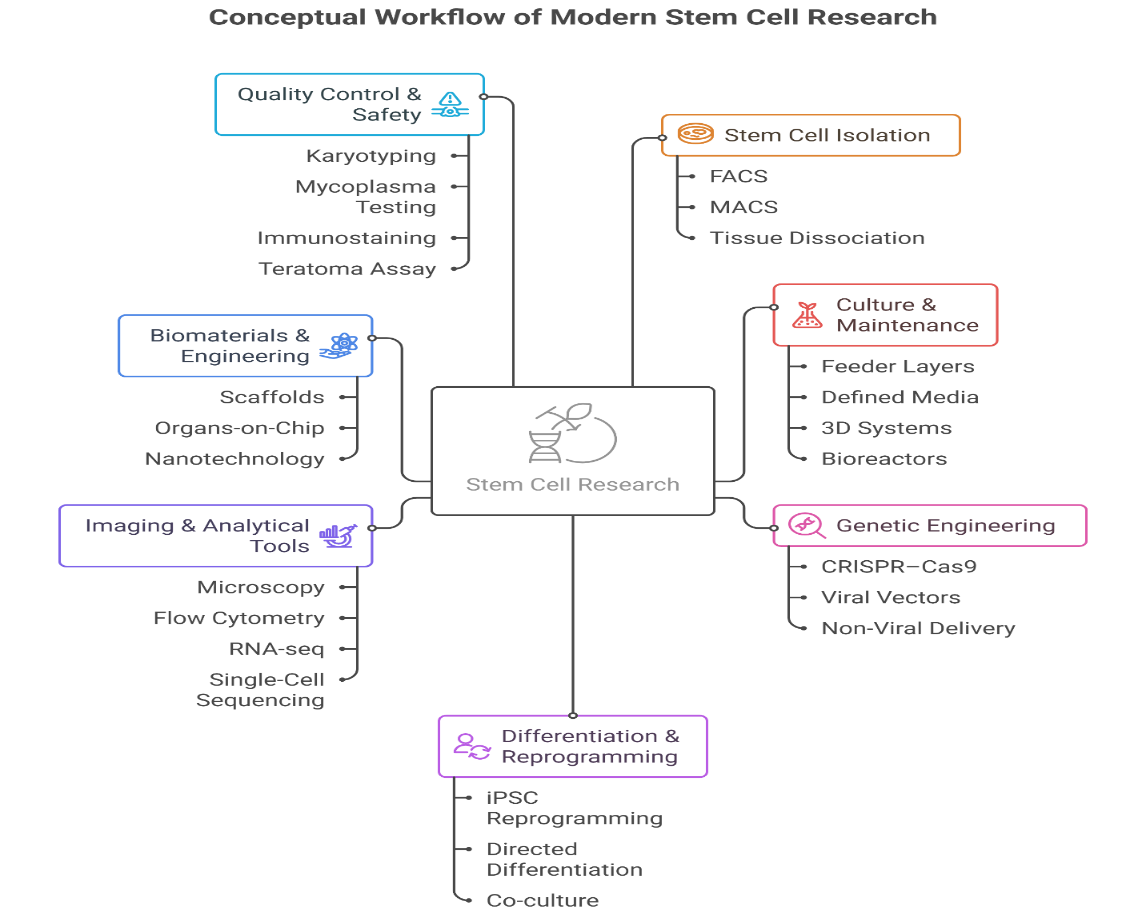
The research on stem cells relies on a wide range of laboratory methods and analytical tools that enable scientists to isolate stem cell populations, maintain them in a stable state, regulate their differentiation, engineer their genomes, and assess their biological characteristics. These technologies, combined, form a comprehensive workflow, from the initial processes of cell extraction through the final phase of cell characterization and safety verification, which will help one gain an accurate understanding of stem-cell behavior and ensure its use in therapy or production.
Stem Cells Isolation Techniques
The isolation of stem cells requires techniques that increase the concentration of specific cell types within complex tissues. Cells may be purified by fluorescence-activated cell sorting (FACS), which identifies and isolates cells with fluorescently labeled surface markers in a particular and quantitative manner (Liu et al., 2015). Magnetic-activated cell sorting (MACS) is a technique for stem cell isolation that relies on the binding of antibody-coated magnetic beads to cells, with minimal handling. Meanwhile, tissue dissociation methods, either enzymatic (e.g., collagenase or trypsin) or mechanical, disaggregate solid tissues (e.g., bone marrow, adipose tissue, umbilical cord blood), releasing viable stem cells for subsequent culture and experimentation (Jia et al., 2018).
Stem Cell Culture and Maintenance
The growth of stem cells requires well-regulated conditions that do not compromise self-renewal or lead to unwanted differentiation. Traditional systems use fibroblast feeder layers, which provide nutrients and other growth factors, while more advanced laboratories use feeder-free, chemically defined media to eliminate variability and ensure reproducibility (Ghasemi-Dehkordi et al., 2015). Three-dimensional culture systems include spheroids and organoids, in which stem cells can self-organize into structures resembling native tissues (Scalise et al., 2021). To achieve such large-scale growth, bioreactors can provide high control over temperature, oxygen, fluid flow, and nutrient exchange to help produce stem cells in a uniform quantity and state suitable for research or therapeutic use (Palladino et al., 2024).
Genetic Engineering in Stem Cells
Genetic manipulation has become the focus of research in stem-cell biology and the production of therapeutic cell products. The CRISPR-Cas9 technology provides a highly specific method for modifying gene sequences, which can be used to correct mutations, generate knockouts, or probe gene function (Chen & Knoepfler, 2016). Viral vectors, such as lentiviral, retroviral, and adenoviral vectors, remain effective for introducing genes into stem cells and stabilizing them. Electroporation, plasmid transfection, and lipid nanoparticles are safer alternatives to viral methods, especially for the production of clinical-grade stem-cell products that do not necessitate genomic disruption (Attia et al., 2021).
Differentiation and Reprogramming Techniques
Differentiation and reprogramming permit regulation of switches between the state of a stem cell and a specialized lineage. Directed differentiation has been shown to recreate significant developmental signals through the aid of specified growth factors and signaling modulators to develop neurons, cardiomyocytes, hepatocytes, and blood cells, among other differentiated cells. The reprogramming protocols reverse the differentiation of the somatic cells to induced pluripotent stem cells (iPSCs) by expressing transcription factors comprising OCT4, SOX2, KLF4, and c-MYC and regain the pluripotency. Co-culture techniques also facilitate subsequent differentiation of the lineage as lineage by co-culture of stem cells on supportive niche cells, creating a micro-environment of physiological development and remodeling (Tanabe, 2015).
Imaging and Analysis Tools
Imaging and molecular profiling devices are the key to comprehending the behavior of stem cells. Confocal and fluorescence microscopy provide the visualization of cell morphology, the place of proteins, and lineage-sensitive markers with high quality, and live cell imaging has been performed to observe dynamic processes throughout self-renewal or differentiation. Flow cytometry offers the capability of a quick assessment of multi-parameter surface markers, viability, and cell-cycle status. Genomic and transcriptomic technologies like RNA sequencing, single-cell sequencing, and quantitative PCR map the molecular identities and the lineage paths. Proteomic and metabolomic studies are also used to complement these techniques and determine the changes in protein networks and metabolic pathways that accompany differentiation, maturation, or cellular stress (Issa et al., 2022).
| Application area | Human example | Animal example |
|---|---|---|
| Regenerative medicine | Remestemcel-L-rknd (MSC) for pediatric steroid-refractory aGVHD (Mahat et al., 2025). | Mesenchymal stem cells for equine tendon repair (Schnabel and Koch, 2023) |
| Drug testing & discovery | Patient-derived intestinal organoids for cystic fibrosis drug repurposing (De Poel et al., 2023). | Porcine pancreatic ductal organoids benchmarked for drug screening (Karampelias et al., 2025). |
| Personalized medicine | Exagamglogene autotemcel (exa-cel) for sickle cell disease (Frangoul et al., 2024). | Canine mammary tumor organoid living biobank for precision oncology (Inglebert et al., 2025). |
| Organ and tissue engineering | Holoclar (autologous limbal stem-cell therapy) for LSCD (Pellegrini et al., 2018). | Porcine islet-derived organoids as transplantable source (Sakata et al., 2024). |
| Agricultural & industrial | Human iPSC-derived 3D skin equivalents for cosmetics irritation testing (Shin et al., 2025). | Sustained expansion of bovine satellite cells for cultivated meat (Stout et al., 2022). |
Biomaterial and Tissue Engineering Tools
Biomaterials also have a significant impact on the fate of stem cells, both through physical support and biochemical signaling. The scaffolds, which consist of collagen, hydrogels, polylactic acid, and others, are designed to induce adhesion, proliferation, and differentiation, and are designed to replicate the extracellular matrix architecture (Bruggeman et al., 2019). Microfluidic organ-on-a-chip systems incorporate a high level of control and physiological environment, such as flow, gradient, and mechanical forces. Nanotechnology builds these possibilities with nanoparticles, nanofibers, and nano-patterned surfaces that modulate the cell signaling, organization, and lineage determination at the sub-micron scale to provide more complex models of tissue development and repair (Corral-Nájera et al., 2023).
Quality Control and Safety
Quality control systems help in assuring that the stem-cell products remain stable, unidentified, and pure during culture as well as their usage. Karyotyping and genomic integrity help in detecting chromosomal abnormalities, and mycoplasma and pathogen tests help in preventing contamination. The pluripotency is verified with the assistance of teratoma-formation assays, which show the ability to develop derivatives of all three germ layers in vivo. Lineage-specific markers can be immunostained to give additional confirmation that the target cell types with the appropriate biological properties were produced by differentiation or reprogramming regimens (Martins & Ribeiro, 2025). Fig. 2 illustrates the conceptual workflow of modern stem cell research.
AI AND STEM CELLS RESEARCH
AI in the Prediction of Cell Differentiation
Artificial intelligence of stem-cell differentiation dynamism based on patterns of gene expression, chromatin state, and time-lapse cellular behavior is gaining increasing use. Machine-learning algorithms have the capability of identifying minor signals of molecules that correspond to the shift toward lineage commitment and allow researchers to foretell whether cells will differentiate into neural, cardiac, or mesodermal cells. These predictive protocols increase the differentiation quality, diminish experimental deviation, and specify sensible design of lineage-wide procedures, revealing the hidden patterns that can be seen straightforwardly by conventional analysis (Mazalan et al., 2023).
Automation in Stem Cell Culture
The automation of stem cell culture AIs is transforming the stem cell culture methods with the integration of robotics, real-time imaging systems, and environmental control systems. Media, cell passaging, and selection of colonies are held fixed with minimal error by human hands with automated systems. AI algorithms are used to study the morphology of colonies, display the first signs of differentiation, and adjust the conditions of the culture. It makes highly standardized and scalable structures capable of producing uniform batches of stem cells to be replicated in research, disease models, or produce clinical quality products with greater efficiency and the least human resources (Daniszewski et al., 2018).
Data Analysis Using AI For Images and Omics Data
AI provides mighty tools to calculate advanced stem-cell data, including microscopy data, transcriptomics data, epigenomics data, proteomics data, and data from single-cell sequencing. Deep-learning cell type models, cell morphology measurements, rare cell group identification, and developmental trajectory prediction are all based on high-dimensional data. A multimodal omics and imaging combination enhances the cell state and regulatory network mapping. Such possibilities of analytical tools facilitate the discovery process because they can reveal the relationships and patterns not considered by the traditional statistical approach (Zhang et al., 2025).
Future AI-Based Discovery Pipelines
The discovery pipelines of the next generation will be associated with the implementation of AI and the high-volume stem-cell platforms that will enable automation of hypothesis generation, design experiments, and validation. Artificial intelligence simulations would be able to predict the most effective differentiation cues, the site of gene editing, as well as small-molecule agonists, even before testing them in the laboratory: Robotics, multi-omics, and real-time feedback. The introduction of this into closed-loop systems would likewise provide a chance to refine the protocols systematically and explore new systems of lineage control. Under such pipelines, they will be guaranteed to have quicker and more effective breakthroughs in regenerative medicine, cell therapy development, and precise tissue engineering (Marei, 2025).
ETHICAL CONSIDERATIONS
Stem cells continue to be a hot ethical topic since the power to obtain the cells would necessitate the killing of early human embryos and potentially cast serious doubts on human dignity and the moral standing of the embryo, and limit acceptable science. Informed consent and donor rights are decisive: the donor should be well informed about how their tissues and cells will be used, stored, and even commercialized, and consent systems should be updated to represent current usages and uncertainty in the future. The emergence of unregulated stem-cell clinics doing unproven treatments is very dangerous: patients will face risks of harm, exploitation, loss of money, and false hope in treatment in the eyes of ordinary people who may trust in legitimate science. Religion and cultural orientations also influence the perceptions of societies regarding stem-cell research; some of the ways social perceptions impact policy and public participation include the interpretations of the timing of human existence, the appropriateness of using embryos, and the human intervention in the natural world. Striking the balance between innovation and responsibility implies that researchers, regulators, and society need to compromise the conflict between the fast rate of biomedical development and the high ethical standards, so that the progress should not be made at the cost of human rights, safety, or equity (Sipp et al., 2018).
FUTURE DIRECTIONS
There is great attention on off-the-shelf, in-body, innovative, and globally accessible therapies as the future directions of stem cell research. Gene-edited universal donor cells are aimed at eliminating or altering immunogenic molecules such that one cell line can be used to treat numerous recipients, save the necessity of patient-specific products, and eliminate complicated matching. Simultaneously, in vivo regeneration aims at reprogramming cells within the body itself, specifically, local support cells into functional tissue (a cardiomyocyte or a neuron) at the location of injury, thus avoiding transplantation and big ex vivo culture processes. Technologically, the sector is shifting towards integrated platforms where 3D bioprinting is used to form tissue architecture, artificial intelligence is used to optimize differentiation and quality control, and nanotechnology is used to give a signal or editing tools at high precision. Ultimately, future development will be evaluated in terms not only of scientific refinement but also in terms of fairness: the increased capacity to manufacture globally, unification of regulations, development of workforce proficiency, and reduction of costs will be required to make sure that stem cell treatments will be available to patients in non-specialized facilities, as well as in high-end ones.
CONCLUSION
Stem cell science has become the nexus of biology, engineering and computational innovation and has given never-before-seen insights into how cells differentiate and fix tissues and respond to disease. On the one hand, there are embryonic, adult and induced pluripotent stem cells, each type of which is of significance to regenerative medicine, disease-modelling and therapeutic discovery. On the other hand, there are more specialised groups of cells (e.g., MSCs, HSCs and NSCs). The reliability is supported by the advancement of culture systems and genetic engineering, organoids, imaging and quality control and ethical and social aspects ensure that the advancement is accountable and transparent. Artificial intelligence combined with automation and multi-omics analytics is changing how differentiation is predicted, how data is processed and how treatments are manufactured. As a solution for the future, the concepts of universal donor cells, in vivo reprogramming, and bioengineered tissues are more promising. Together, these discoveries have rendered stem cell research among the pillars of possible breakthroughs in biomedical and health research in the world in the future.
References
- Ajmal L, S Ajmal, M Ajmal et al., 2023. Organ regeneration through stem cells and tissue engineering. Cureus 15:34336.
- Attia N, M Mashal, G Puras et al., 2021. Mesenchymal stem cells as a gene delivery tool: promise, problems, and prospects. Pharmaceutics 13:843.
- Ávila-González D, MÁ Gidi-Grenat, G García-López et al., 2023. Pluripotent stem cells as a model for human embryogenesis. Cells 12:1192.
- Benayahu D, 2022. Mesenchymal stem cell differentiation and usage for biotechnology applications: tissue engineering and food manufacturing. Biomaterials Translational 3:17.
- Boisset JC & C Robin, 2012. On the origin of hematopoietic stem cells: progress and controversy. Stem Cell Research 8:1–13.
- Bolideei M, R Barzigar, RB Gahrouei et al., 2025. Applications of gene editing and nanotechnology in stem cell-based therapies for human diseases. Stem Cell Reviews and Reports 21:905–34.
- Bruggeman K, N Moriarty, E Dowd et al., 2019. Harnessing stem cells and biomaterials to promote neural repair. British Journal of Pharmacology 176:355–68.
- Cerneckis J, H Cai and Y Shi, 2024. Induced pluripotent stem cells: molecular mechanisms of induction and applications. Signal Transduction and Targeted Therapy 9:112.
- Chen G, S Yin, H Zeng et al., 2022. Regulation of embryonic stem cell self-renewal. Life 12:1151.
- Chen KY & PS Knoepfler, 2016. To CRISPR and beyond: the evolution of genome editing in stem cells. Regenerative Medicine 11:801–16.
- Chen Y, J Shentu, H Lou et al., 2024. Hematopoietic stem cell heterogeneity and age-related platelet bias. Stem Cell Research and Therapy 15:459.
- Corral-Nájera K, G Chauhan, SO Serna-Saldívar et al., 2023. Polymeric and biological membranes for organ-on-a-chip devices. Microsystems and Nanoengineering 9:107.
- Daniszewski M, DE Crombie, R Henderson et al., 2018. Automated cell culture systems and their applications to human pluripotent stem cell studies. SLAS Technology 23:315–25.
- De Morree A & TA Rando, 2023. Regulation of adult stem cell quiescence and its functions in the maintenance of tissue integrity. Nature Reviews Molecular Cell Biology 24:334–54.
- De Poel E, S Spelier, M Hagemeijer et al., 2023. FDA-approved drug screening in patient-derived organoids demonstrates potential of drug repurposing. Journal of Cystic Fibrosis 22:548–59.
- Della Rocca Y, A Mazzone, GD Marconi et al., 2025. Stem cells in regenerative medicine: a journey from adult stem cells to induced pluripotent cells. International Journal of Molecular Sciences 26:8255.
- El-Tanani M, SA Rabbani, SM Satyam et al., 2025. Deciphering the role of cancer stem cells. Cancers 17:382.
- Fiori ME, L Villanova and R De Maria, 2017. Cancer stem cells: at the forefront of personalized medicine and immunotherapy. Current Opinion in Pharmacology 35:1–11.
- Frangoul H, F Locatelli, A Sharma et al., 2024. Exagamglogene autotemcel for severe sickle cell disease. New England Journal of Medicine 390:1649–62.
- Galderisi U, G Peluso and G Di Bernardo, 2022. Clinical trials based on mesenchymal stromal cells are exponentially increasing. Stem Cell Reviews and Reports 18:23–36.
- Ghasemi-Dehkordi P, M Allahbakhshian-Farsani, N Abdian et al., 2015. Effects of culture conditions on stem cell optimization. Proceedings of the National Academy of Sciences India Section B 85:711–7.
- Ghazimoradi MH, A Khalafizadeh and S Babashah, 2022. A critical review on induced totipotent stem cells. Stem Cell Research 63:102857.
- Guan J, G Wang, J Wang et al., 2022. Chemical reprogramming of human somatic cells to pluripotent stem cells. Nature 605:325–31.
- Hérault L, M Poplineau, E Remy et al., 2022. Single cell transcriptomics to understand HSC heterogeneity. Cells 11:3125.
- Hussen BM, M Taheri, RK Yashooa et al., 2024. Revolutionizing medicine: recent developments and future prospects in stem-cell therapy. International Journal of Surgery 110:8002–8024.
- Inglebert M, M Dettwiler, K Hahn et al., 2022. A living biobank of canine mammary tumor organoids. Scientific Reports 12:18051.
- Issa J, M Abou Chaar, B Kempisty et al., 2022. Artificial-intelligence-based imaging analysis of stem cells. Biology 11:1412.
- Jia Z, Y Liang, X Xu et al., 2018. Isolation and characterization of mesenchymal stem cells from synovial fluid. Cell Biology International 42:262–71.
- Karampelias C, K Yang, FJ Farkas et al., 2025. Benchmarking porcine pancreatic ductal organoids. EMBO Molecular Medicine 17:3657–88.
- Kirkeby A, H Main and M Carpenter, 2025. Pluripotent stem-cell-derived therapies in clinical trial. Cell Stem Cell 32:10–37.
- Lathia JD & H Liu, 2017. Overview of cancer stem cells and stemness. Targeted Oncology 12:387–399.
- Lee H, B Kim, J Park et al., 2025. Cancer stem cells: landscape, challenges and emerging therapeutic innovations. Signal Transduction and Targeted Therapy 10:248.
- Linh NT, NH Qui and A Triatmojo, 2022. Effect of nano-encapsulated herbal essential oils on poultry health. Archives of Razi Institute 77:2013.
- Liu L, TH Cheung, GW Charville et al., 2015. Isolation of skeletal muscle stem cells. Nature Protocols 10:1612–24.
- Liu X, Z Zhou, Y Zhang et al., 2025. Recent progress on organoids. Biomedicine and Pharmacotherapy 185:117942.
- Lou S, Y Duan, H Nie et al., 2021. Mesenchymal stem cells: biological characteristics and applications. Biochimie 185:9–21.
- Lovell-Badge R, E Anthony, RA Barker et al., 2021. ISSCR guidelines for stem cell research. Stem Cell Reports 16:1398–1408.
- Mahla RS, 2016. Stem cells applications in regenerative medicine. International Journal of Cell Biology 2016:6940283.
- Mahat U, D Przepiorka and LA Fashoyin-Aje, 2025. Remestemcel-L-rknd for steroid-refractory acute GVHD. JAMA 334:81–82.
- Majo F, A Rochat, M Nicolas et al., 2008. Oligopotent stem cells in the ocular surface. Nature 456:250–4.
- Marei HE, 2025. Smarter stem cells: AI and iPSC technology. Cell and Tissue Research 402:283–300.
- Martins F & MH Ribeiro, 2025. Quality and regulatory requirements for iPSC manufacture. Stem Cell Reviews and Reports 21:645–79.
- Mazalan M, TD Do, WSWK Zaman et al., 2023. Machine learning approaches for stem cells. Current Stem Cell Reports 9:43–56.
- Mendi BI, R Hirani, A Sayegh et al., 2025. Utilization of stem cells in medicine. International Journal of Molecular Sciences 26:9659.
- Metallo CM, SM Azarin, L Ji et al., 2008. Engineering tissue from human embryonic stem cells. Journal of Cellular and Molecular Medicine 12:709–29.
- Mohamed-Ahmed S, I Fristad, SA Lie et al., 2018. Adipose-derived and bone marrow mesenchymal stem cells. Stem Cell Research and Therapy 9:168.
- Monti M, 2021. Perinatal stem cells biology and translational medicine. European Journal of Histochemistry 65:3291.
- Park SJ, YY Kim, JY Han et al., 2024. Advancements in human embryonic stem cell research. Tissue Engineering and Regenerative Medicine 21:379–94.
- Pellegrini G, D Ardigò, G Milazzo et al., 2018. Market authorization of Holoclar. Stem Cells Translational Medicine 7:146–54.
- Poliwoda S, N Noor, E Downs et al., 2022. Stem cells: a comprehensive review. Orthopedic Reviews 14:37498.
- Quesenberry PJ, S Wen, LR Goldberg et al., 2022. The universal stem cell. Leukemia 36:2784–92.
- Sakata N, G Yoshimatsu, R Kawakami et al., 2024. Porcine islet-derived organoids. Scientific Reports 14:6401.
- Scalise M, F Marino, L Salerno et al., 2021. From spheroids to organoids in cardiac regeneration. International Journal of Molecular Sciences 22:13180.
- Schnabel LV & DW Koch, 2023. Mesenchymal stem cells for tendon healing. Journal of the American Veterinary Medical Association 261:1435–42.
- Shin H, SE Kim, CY Kim et al., 2025. Skin irritation testing using human iPSC-derived models. PLoS One 20:0330306.
- Sipp D, M Munsie and J Sugarman, 2018. Emerging stem cell ethics. Science 360:1275.
- Sobhani A, N Khanlarkhani, M Baazm et al., 2017. Multipotent stem cell and current application. Acta Medica Iranica 55:6–23.
- Stout AJ, AB Mirliani, ML Rittenberg et al., 2022. Serum-free expansion of bovine satellite cells. Communications Biology 5:466.
- Tanabe S, 2015. Signaling involved in stem cell reprogramming. World Journal of Stem Cells 7:992.
- Tang XY, S Wu, D Wang et al., 2022. Human organoids in basic research. Signal Transduction and Targeted Therapy 7:168.
- Torre Pdl & AI Flores, 2020. Perinatal stem cells. Genes 12:6.
- Velarde V, P Desco and MV Gómez-Gaviro, 2022. Neural stem cell niches. Cells 11:3002.
- Wu X, X Yang, Y Dai et al., 2024. Single-cell sequencing to multi-omics. Biomarker Research 12:110.
- Xiao Y, CS McGuinness, WS Doherty-Boyd et al., 2022. Bone marrow niche insights. Biomaterials 286:121568.
- Zakrzewski W, M Dobrzyński, M Szymonowicz et al., 2019. Stem cells: past, present, and future. Stem Cell Research and Therapy 10:68.
- Zhang J, Y Che, R Liu et al., 2025. Deep learning–driven multi-omics analysis. Briefings in Bioinformatics 26:440.
- Zhao X & DL Moore, 2018. Neural stem cells. Cell and Tissue Research 371:1–6.