

INTRODUCTION
The 21st century has also been characterized by an unprecedented scientific and technological advancement that has reshaped human health outcomes all over the world. The field of genomics, biotechnology, artificial intelligence (AI), and digital health has considerably enhanced the process of disease prevention, diagnosis, and treatment. The World Health Organization indicated that the global life expectancy rose by over six years between the years 2000 and 2022, which was mainly because of the progress in medical technology, vaccination, and the improvement of the health infrastructure. Precision medicine and other AI-enhanced diagnostics breakthroughs have allowed people to detect diseases earlier and select treatment options based on an individual’s needs, which have resulted in better survival and quality of life in most populations (Rajendran et al., 2025).
Growing Concepts of Health and Social Determinants
Contemporary health systems adopt the concept of health as a holistic physical, mental, and social well-being and not just the lack of illness. Studies have shown that a substantial rate of health outcomes in the world is explained by social determinants, such as income, education, employment, women's equality, and the situation in the environment (Marmot, 2020). The people with lower socioeconomic backgrounds had a higher lethality rate during the COVID-19 pandemic because of the lack of access to healthcare services and digital health. Such inequalities underscore the fact that medical innovation can never ensure population health improvements without enhancing structural and social inequalities.
Digital health technologies have changed the landscape of healthcare delivery in the 21st century. Access to care, especially in high-income and urban environments, has been enhanced with the help of telemedicine, wearable devices, and AI-driven analytics. Nevertheless, the statistics on the level of digital health access indicate that the inequalities are substantial worldwide. About 37 percent of the world population does not have access to quality internet, thus limiting the availability of telehealth services in low and middle-income nations (Mahmoud et al., 2022). This digital health disparity has the potential to expand the existing disparities in health care unless digital infrastructure inclusion and global cooperation are given priority.
Environmental and Mental Health Dilemma in the Contemporary Age
In the 21st century, environmental and psychosocial determinants have become essential determinants of health. Climate change is expected to result in an increase in deaths by 250,000 people per year between 2030 and 2050 because of malnutrition, heat stress, and infectious diseases. At the same time, the mental health issue is an expanding burden on the world, and around one out of eight individuals worldwide has a mental health problem. The challenges of urbanization, social isolation, and economic uncertainty have aggravated mental health risks, and combined healthcare strategies that focus on environmental sustainability and psychological well-being are necessary (Rao, 2025).
GLOBAL HEALTH CHALLENGES
Non-Communicable Diseases (NCDs) Emergence
More than 70% of deaths on our planet are due to non-communicable diseases, including cardiovascular disorders, cancer, diabetes, and chronic respiratory diseases. This burden is caused by urbanization, sedentary lifestyle, bad diet and tobacco use. Compared to infectious diseases, NCDs require management and are expensive to treat, thus posing a major risk to the health systems of the world (Frenk & Moon, 2013).
Diseases of the Future: Epidemic and Pandemics
The 21st century has also found itself in the midst of several pandemics, such as SARS (2003), H1N1 (2009), Ebola (2014) and COVID-19 (2019), which have proved that the world populations are still vulnerable to infectious diseases. The COVID-19 pandemic specifically led to the revelation of vulnerabilities in the health infrastructure of the population, vaccine equity, and international collaboration. Early detection, genomic surveillance, and cross-border health collaboration have to be considered as the future preparedness (David & Ozuluoha, 2020). Climate change is an increasingly dangerous threat to human health due to the increase in temperatures, air quality, food security, and water shortages. Climate change has been listed as the most significant health challenge of the century. More vectors such as malaria, displacement by floods and mental strain of environmental catastrophe all indicate the overlap of planetary and human health.
Mental Health Crisis
The pressures of social media, economic insecurity, and busy schedules are modern stressors that have resulted in a disturbing rise in rates of anxiety, depression, and suicide across the globe. Access to quality mental healthcare is still uneven, even in the wake of increased awareness. The stigma of having a mental illness, particularly in low-income areas, is the factor that still makes millions of people refuse to seek assistance (Patel et al. 2018).
BREAKTHROUGH IN THE HEALTH OF HUMANS
Personalized Healthcare and Genomic Medicine
Genomic medicine is one of the most prominent innovations in the contemporary healthcare system that has revolutionized the way diseases are diagnosed, prevented, and cured. The successful Human Genome Project was revealed in 2003, and it became a turning point because it opened the door to the reading and analysis of the complete human genetic code (Recharla et al., 2023). This breakthrough was the basis of precision medicine- a style of medicine that personalizes treatment and prevention interventions based on the genetic make-up, the environment, and the lifestyle of an individual
Precision medicine does not follow the conventional model in which a one-size-fits-all approach is expected to address all needs of patients, but acknowledges that every patient may respond to a drug or a treatment differently. With the determination of genetic mutations and biomarkers, medical workers can forecast the reaction of the patient to certain medications, which enhances the effectiveness of treatment and decreases adverse outcomes (Pirmohamed, 2014). To illustrate, in cancer treatment, genetic profiling will enable clinicians to direct cancer-causing mutations with personalized cancer therapies, including psychotherapies and drug targeting genes. This has seen impressive advancements in the treatment of such diseases as breast cancer, leukemia, and melanoma.
Genomics medicine as a preventative healthcare is another important aspect of genomics medicine. Genetic screening helps to identify at-risk individuals at a very early age, major hereditary illnesses like cystic fibrosis, Huntington's disease and some cardiovascular diseases. Since detection of these risks is in its early stages, lifestyle adjustments and medical interventions can be carried out even before the symptoms manifest. It is a proactive model that changes healthcare into a reactive one, where it is involved in the treatment of illness, to a preventive model, whose emphasis is on wellness and longevity (Haque et al., 2016).
Additionally, new developments in the area of genomics medicine, like pharmacological, have transformed the way drugs are developed. With the knowledge of the genetic variations that are known to influence or interfere with the metabolism of the drugs, scientists are able to come up with safer and more effective drugs. This has brought about the development of individual prescriptions, reducing the side effects and enhancing results. Nevertheless, ethical and social concerns such as genetic privacy, discrimination, and inequality of access are also brought up by genomics medicine. Genome sequencing is expensive and this may limit its access in the low and middle-income countries, potentially increasing the health equity divide. Ethical principles are, therefore, needed to make sure the genetic information is applied in a sensible manner and that the impact of the genomics studies is shared worldwide. Genomic medicine will become even more intertwined with artificial intelligence (AI) and big data analytics in the upcoming decades that will allow real-time analysis of genetic data and provide individualized treatment recommendations. With the advancement of these technologies, the future of genomic medicine is to keep changing the face of healthcare, as it will empower people with the information on their genetic vulnerability and help determine the future of personalized, predictive and preventive medicine (Adhikary et al., 2023).
Digital Health and Artificial Intelligence (AI)
Artificial Intelligence (AI) is one of the most recent, revolutionary changes in the healthcare industry, where it is transforming healthcare disease diagnosis, monitoring, and control processes (Fig. 1). Through the artificial intelligence process, medical data are processed speedily and accurately in large volumes through the simulation of human intelligence. AI has turned out to be an essential part of modern medicine, starting with early disease identification to the customization of the treatment plan (Singh et al., 2024). Medical diagnostics can be considered one of the most impressive contributions of AI. Rather, algorithms that have been trained on millions of medical images are now capable of detecting radiology, pathology, and dermatology abnormalities with precision comparable (or even better) to that of human experts. As an illustration, AI-based devices are able to detect the early signs of breast cancer or lung nodules that might not be detected by clinicians and provide an opportunity to intervene sooner and enhance results. Equally, AI in ophthalmology also helps to identify diabetic retinopathy and other eye diseases at an early age, preventing blindness among people who may be at risk (Singh et al., 2024).
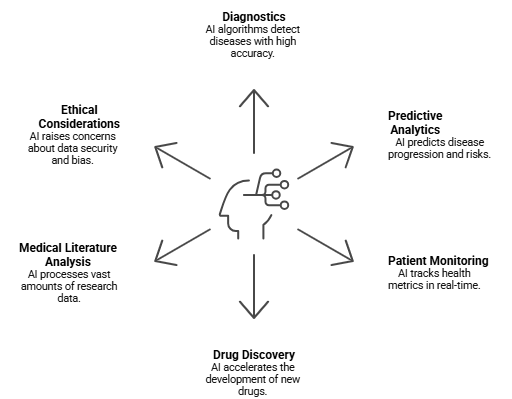
Besides diagnostics, AI has transformed predictive analytics and patient monitoring. The predictions of diseases progression or the risk of hospital readmission or possible complications can be done based on patient data analyzed by machine learning models. The tools of AI became instrumental during the COVID-19 pandemic, with the ability to monitor the rates of infections, analyze the effectiveness of vaccines, and healthcare management resources. In addition, health and remote monitoring solutions saw a massive spread in the course of the period, which guaranteed continuity of care to patients in lock downs and rural locations. Smart devices like smartwatches and fitness bracelets, in which AI is used as the power source, can track heart rate, oxygen levels, and sleep habits in real-time, providing information that can be used to encourage proactive health care. Drug discovery is also achieved through AI which analyses biological data to determine possible therapeutic compounds quicker than traditional research. This has reduced radically the duration and the cost incurred to come up with new drugs. Moreover, natural language processing tools make it possible to analyze medical literature, and thus, researchers can draw relevant conclusions of large scientific databases with efficient tools (Malik et al., 2021).
Nevertheless, the application of AI in healthcare is associated with a number of ethical and practical issues. The problems of data security, bias in algorithms and transparency should be resolved to keep trust to AI-based systems. Prejudice in training data may result in unequal healthcare results, especially to the underrepresented population. Also, it is feared that automation can rob healthcare of its personality or occur at the expense of some professional jobs. Therefore, AI should not be regarded as a replacement of human knowledge, but rather, as an addition. Further development of digital health will require the cooperation of clinicians, data scientists, and policymakers to make AI technologies safe, ethical, and affordable to everyone. AI can transform healthcare into a more predictive, precise, and personalized field when introduced responsibly, and it will consequently redefine the field of medicine in future generations (Kothinti, 2024).
VACCINE BIOTECHNOLOGY AND INNOVATION
Innovation in the field of vaccines and biotechnology has achieved unprecedented evolution in the 21st century and was especially emphasized during the COVID-19 pandemic due to its rapid response. The vaccines have always been some of the most excellent instruments of public health, yet by the recent developments in biotechnology, it has been improved by a lot in speed, effectiveness and flexibility. An example that has caused a revolution in the field of immunology is the development of mRNA-based vaccines, including those created by Pfizer-BioNTech and Moderna (Ivanova, 2025). In contrast to the old methods of vaccination when weakened or killed viruses are used, mRNA vaccines carry the genetic code that instructs the cells of the body to generate non-hazardous parts of a virus, resulting in the formation of immunity. This new technology enables faster designing and manufacturing of vaccines and this proved to be extremely critical during the COVID-19 pandemic. Less than a year after the discovery of the SARS-CoV-2 virus, researchers were able to develop and send vaccines to billions of individuals a process that would have historically taken one decade.
In addition to COVID-19, efforts are underway to use mRNA vaccine platforms to fight other infectious diseases like malaria, HIV, and influenza. Their potential is also under research in cancer immune therapy, in which vaccines would be used to engineer the immune system to attack tumor-specific antigens. This is a huge step forward in individual vaccine treatment, a research area that incorporates immunology, genomics, and biotechnology to develop solutions. Gene editing and synthetic biology have also been revolutionized with the help of biotechnology. Scientists can now edit genes more than ever before, using tools like CRISPR-Cas9, which is providing a future cure to genetic illnesses like sickle cell anemia and muscular dystrophy (Koff et al., 2023). Moreover, bio manufacturing has also allowed the creation of vaccines and biologic in large scale, being more efficient and lowering costs (Adhikary et al., 2023).
Nevertheless, the sheer modernity of the innovation of biotechnology poses ethical, safety and accessibility issues as well. In the case of gene editing, moral limits are put to the test because it introduces the idea of manipulating human embryos. Equally, the disparities in access to vaccines amid the COVID-19 pandemic demonstrated how the global disparities were deeply rooted, with the wealthiest states acquiring the vaccines significantly before the low-income nations. This highlights the importance of the fair allocation and global cooperation whereby life-saving bio-technologies be availed to the entire populations. The new trends in vaccine innovation will be centered on universal vaccines, which can protect against more than one strain of a virus, and nanotechnology-based delivery systems, which can boost the immune system. Ongoing biotechnology research has the promise of eradicating some of the most chronic human illnesses and ushering in the new age of preventive medicine. Biotechnology and the collaboration of the world will continue to be pivotal in terms of making sure that such breakthroughs will translate into sustainable changes in global health (Labonté et al., 2022).
INTENSIVE AND PREVENTIVE HEALTH
The 21st century has seen a transformation of the healthcare model from being disease-focused to a preventative, wellness-focused, and holistic health model. The preventive and integrative strategies accept the fact that physical, mental, and social health are all interrelated and should be treated as a whole to attain sustainable health outcomes. Integrative health is a combination of conventional medicine and evidence-based supplementary therapy, which includes nutrition, exercise, mindfulness, and stress management. This model promotes a personal active involvement in health by means of lifestyle change, preventive screening, and wellness programs. Research has indicated that preventive precautions like regular exercise, maintaining balanced foods, and early screening programs can lessen the occurrence of long-term illnesses like diabetes, coronary illness and high blood pressure. Over the past years, there has been a growing popularity of the use of lifestyle medicine in health care systems, a field that targets the causes of disease as opposed to symptom treatment. Lifestyle medicine enables individuals to be in control of their health by addressing the risk factors that can be modified, such as smoking, poor diet, and exercise. As an illustration, a vegetarian diet and physical exercise have been found to lower inflammation and enhance cardiovascular performance (Ali & Katz, 2015).
Mental health is very important in integrative care as well. Physical health outcomes and psychological well-being are related to each other. Curricula based on mindfulness meditation, counselling and cognitive behavioral therapy (CBT) have been successful in anxiety, depressive, and stress-related diseases. Integrative models also promote workplace wellness programs and school-based health education as a means to increase long-term behavior change. Preventive healthcare does not only apply to the behavior of the individual but to the societal health, like vaccination, access to clean water, pollution and nutritional programme. This is because prevention is cost-effective and sustainable since governments and organizations worldwide are investing in community health programs that take into consideration the social determinants of health, which include education, income, and environment (Adhikary et al., 2023).
Nevertheless, in spite of obvious advantages, preventative healthcare is not fully funded and attended in comparison with curative medicine. This ratio indicates a structural problem: the societies are more likely to invest in curing once a disease is present as opposed to prevention when a disease has not developed. In order to deal with this, the policymakers should focus on prevention structures, insurance schemes, and awareness. Preventive health is also further increased in the integration of digital technology. By using mobile health apps, wearable technology, and health, real-time monitoring, and early detection of health problems can be performed, enabling individuals to make informed decisions. Finally, integrative and preventative healthcare is a long-term vision of the future one that integrates medical science, behavioral health, and community support. It is possible to save on healthcare expenses, enhance living standards and develop resilient health systems that will support future generations by preventing diseases, and responding to them only after occurrence (Labonté et al., 2022).
The Connection Between Technology and Global Health Equity
In the 21st century, technology is one of the strongest factors influencing human health. Artificial intelligence (AI) diagnostics, medicine, robotics, and digital health records are all a result of innovation that has transformed the manner in which healthcare is delivered, accessed, and engaged in. These advances have eliminated several old obstacles, such the possibility of consulting remotely, faster disease detection, and effective management of data. As an example, medicine will allow physicians to treat patients in distant areas without the need to be physically present, and AI-based imaging technologies can help in the early diagnosis of cancer and cardiovascular diseases. Such developments have helped to turn healthcare systems into more efficient, patient-centered and data-driven models (Arora, 2020).
Nonetheless, in spite of the potential transmogrification of technology, it has increased inequalities in the world. The rich countries enjoy the fruits of digital innovation too much, whereas poor countries frequently cannot even count on basic healthcare services. The digital health divide represents the differences in access to the required infrastructure, including reliable internet and digital literacy, as well as medical devices. Indicatively, in the case of the COVID-19 pandemic, countries that had developed digital health ecosystems could afford to develop mass vaccination tracking systems, online health consultation, and digital contact tracing, whereas low-income countries did not. This technological difference has led to lopsided health results, which form a two-tier global healthcare system (Prahalad & Hammond, 2002).
Affordability and sustainability are other issues that digital technology brings up. Although systems based on AI and genomics testing provide accurate solutions to healthcare problems, their cost makes them inaccessible to vulnerable populations. Prevarication of medical information and commercialization of health apps are usually based on profit, rather than equity. Therefore, the development of technologies poses a threat of strengthening socioeconomic inequalities instead of eliminating them (Marmot, 2020). Global health justice necessitates the equitable distribution of innovations and their inclusion to consider the interests of underrepresented groups, rural communities, and people with disabilities. Equitable healthcare is not only about access to technology but also capacity-building in terms of education and training. Indicatively, health workers and patients can be empowered by digital literacy programs to use technology to empower communities. Governments, private components, and international health organizations could be crucial to decreasing the technological gap by collaborating with each other. Examples of inclusive strategies that can promote equality include open-source medical programs, low-cost diagnostic devices, and community-based health programs (Curioso, 2019).
Moreover, technology must be used as a way to strengthen human connection instead of substituting it. Digital health could cause depersonalized care or marginalization of aging patients who are not technologically savvy. Thus, global health equity in digital times should focus on human dignity, empathy and accessibility in addition to innovation. To close the digital divide, there should be systemic cooperation, an international financial system, and ethics that ensure that the fruits of technology are accessible to all persons who are not limited by geographical or economic factors. It is only through the combination of innovation and inclusivity that the promise of digital health can be used to enhance the well-being of the entire humanity (Labonté et al., 2022).
Ethical and Social Considerations
The implementation of sophisticated technologies in healthcare introduces many ethical and social issues that should be taken into account. With the rapid pace of medical innovation, ethical issues related to the privacy of data, genetic engineering and access to high-level treatments have become more pressing. The swift development of artificial intelligence, genomics medicine, and biotechnology requires the establishment of clear models that would be in harmony with scientific achievements and ethical accountability (Zarif, 2022). Data privacy and consent can be regarded as one of the most urgent ethical challenges. To be efficient, AI systems and electronic health records entail a considerable amount of personal information. Although this data is more accurate in diagnoses, it may also increase the possibilities of breaches and abuse. Illegal use of sensitive information, including genetic data or mental health records, may cause discrimination at the workplace or during insurance. It is one of the critical factors that ensure the sustainability of confidence in digital healthcare systems because data gathering must adhere to high ethical standards, with patients' consent and openness.
The second ethical issue is the result of the genomics studies and gene editing technologies like CRISPR-Cas9. Even though the above technologies promise to cure genetic diseases, they also raise ethical issues regarding the issue of manipulating human DNA. The threat of designer babies or genetic improvement provokes the ideas of fairness, equality, and human identity (Doudna and Charpentier, 2020). International regulations and moral control are necessary to avoid abuse. International health organizations should develop regulations that would make genetic interventions to be applicable in treatment and not in non-medical improvements (Ayanoğlu et al., 2020).
There is as well, social disparity in access to the latest medical technologies. The richer groups tend to receive access to newer and more sophisticated therapeutic techniques earlier than the marginalized groups, who are left with old-fashioned techniques. These inequalities are a blow to the ethical value of justice which requires that there are equal distributions of healthcare benefits. Unequal outcomes are caused by the cost of treatments, inadequate healthcare infrastructure and poor awareness. New medical technologies should be afforded, fairly distributed, and accessible to all social classes in terms of access to ethical governance structures, says Marmot (2020).
The other crucial element of the contemporary healthcare ethical environment is the cultural sensitivity. The social perspective of organ donation, mental health and genetic modification differs greatly among different societies. The medical treatments should not violate these cultural beliefs so that patients collaborate with these treatments and the society accepts it. There should also be ethical healthcare practice through community involvement and cultural dialogue instead of applying universal solutions (Patel et al., 2018).
Finally, one should not disregard the role of human values in technological medicine. With the rise of AI and robotics in general within the sphere of patient care, the issue of denationalization and empathy loss in healthcare environments is becoming a major concern. Ethical medicine should protect the humane and human bondage so that technology supports and not substitutes the human touch. With solid ethical pillars based on transparency, accountability and respect, humanity will be able to use innovation in a responsible manner. To make healthcare be used in a dignified, equal and compassionate way, the balance between progress and ethics is necessary to make sure that the sphere remains serving humanity.
FUTURE DIRECTIONS
A combination of technological innovation, environmental sustainability and global cooperation will characterize the future of human health. The future of healthcare systems involves interdisciplinary research and collaboration as the basis of addressing complex health issues like pandemics, mental health crises, and chronic diseases. Prevention, rationalization, and equity should be central to the future of healthcare approaches addressing the challenge of developing resilient and inclusive health systems across the world. The trend toward developing precision medicine is also one of the most promising ones as a method of medical care, which adapts to the unique aspects of each patient, their genetic makeup, environment, and lifestyle. As AI and genomics sequencing are improved, precision medicine is capable of predicting the risk of diseases and preempting them before they happen (Recharla et al., 2023). This reactive-to-proactive change in healthcare will minimize the long-term costs and enhance healthcare outcomes.
Diagnostics, drug discovery, and surgery will persistently be revolutionized with the help of artificial intelligence and robotics. There are disease patterns that AI algorithms can determine on large datasets that humans may miss. Robots are already being used to help in complicated surgeries that are beyond the ability of humans to be precise. Nonetheless, to realize the full potential of these innovations, governments and institutions should invest in digital infrastructures, as well as make sure that advanced technologies are available equally to everyone around the world (Banbhrani et al., 2025).
In the upcoming decades, increased focus on mental health and emotional wellness as part of the general health is also going to be seen. By understanding mental health as a priority area in the public health care system, one will promote investment in prevention and early detection and community-based intervention (Patel et al., 2018). Environmental health will equally be very important. The need to incorporate environmental sustainability in healthcare policy will become necessary as climate change continues to affect the quality of air, food security, and the spread of diseases. It is believed that hospitals of the future will incorporate green supply chains, renewable energy sources, and environmentally friendly buildings to ensure the hospitals have minimal ecological footprint. Digital literacy and education will equally play an important role in deciding the future of healthcare. Responsible use of advanced technologies by healthcare workers can create trust and engagement in digital health programs, as well as patient education about digital tools. International collaboration using agencies like the WHO and the United Nations will still be necessary in order to make sure that knowledge, vaccines, and technologies are distributed fairly across the countries. After all, it is a matter of innovation and inclusiveness that holds the future of human health. The policies need to focus on fair access, good governance, and culture. There will be investments in research, mental health, and sustainable infrastructure to help technological progress impact every community. By working together, being innovative and caring, human beings can create a healthier, more equitable and sustainable future to survive in.
CONCLUSION
To sum up, the notion of human health in the 21st century is a place of opportunity, innovation and responsibility. The blistering technological and scientific progress gives the mankind unprecedented means of fighting off disease, increasing life span, and improving life quality. Recent genomics discoveries to the AI-driven healthcare systems seem to be endless. Nonetheless, these opportunities are also accompanied by significant challenges: the increasing inequality, the problem of moral dilemma and an incessant danger of world crises like pandemics and climate change. In order to achieve a healthy and sustainable future, societies should realize that health is not only a medical problem but a social, ethical, and environmental problem. Any innovation should be based on equity. The highest technologies will remain an exclusive preserve of the privileged without access by the majority and this will continue to create the rich-poor divide. Governments, the business sector, and the international organizations should thus liaise with each other in order to make sure that healthcare innovation does not only favor the rich. It is also important that the human values should be maintained in the technologically oriented world. Empathy, human connection and compassion cannot be replaced in healthcare. Technology has taken the center stage and it has to be steered by humans in a moral and responsible manner. All medical practices should adopt data privacy, patient autonomy and cultural sensitivity. The 21st century gives mankind a chance of an unprecedented scale: to combine science, technology, and morality towards the benefit of the common good. Innovation combined with compassion, ethics, and equity will bring the world to the stage where health will become a right of everyone and not a privilege. The issue is not in the development of technology but in the prudent use of it in the promotion of the entire humankind.
References
- Adhikary S, S Dutta, AD Dwivedi et al., 2023. Secret learning for lung cancer diagnosis: A study with homomorphic encryption, texture analysis and deep learning. Biomedical Physics and Engineering Express 10:015011.
- Ali A & DL Katz, 2015. Disease prevention and health promotion: how integrative medicine fits. American Journal of Preventive Medicine 49:230-40.
- Arora A, 2020. Conceptualising artificial intelligence as a digital healthcare innovation: an introductory review. Medical Devices: Evidence and Research 20:223–30.
- Ayanoğlu FB, AE Elçin, YM Elçin et al., 2020. Bioethical issues in genome editing by CRISPR-Cas9 technology. Turkish Journal of Biology 44:110–20.
- Banbhrani SK, MN Akhter, F Noureen et al., 2025. How AI is revolutionizing healthcare: from personalized medicine and diagnostic tools to drug discovery and robot-assisted surgery. Social Science Review Archives 3:2693–2709.
- Curioso WH, 2019. Building capacity and training for digital health: challenges and opportunities in Latin America. Journal of Medical Internet Research 21:16513.
- David KB & CC Ozuluoha, 2020. Past and present viral pandemics: lessons learnt and future recommendations. International Journal of Health and Life Sciences 2020:108995.
- Frenk J & S Moon, 2013. Governance challenges in global health. New England Journal of Medicine 368:936–42.
- Haque IS, GA Lazarin, HP Kang et al., 2016. Modeled fetal risk of genetic diseases identified by expanded carrier screening. Journal of the American Medical Association 316:734–42.
- Ivanova N, 2025. Biotechnological innovations in vaccine development: lessons from the COVID-19 pandemic. Journal of Commercial Biotechnology 30:143–52.
- Koff WC, DR Burton, PR Johnson et al., 2013. Accelerating next-generation vaccine development for global disease prevention. Science 340:1232910.
- Kothinti RR, 2024. Artificial intelligence in healthcare: revolutionizing precision medicine, predictive analytics, and ethical considerations in autonomous diagnostics. World Journal of Advanced Research and Reviews 19:3395–3406.
- Labonté R, G Martin, KT Storeng et al., 2022. Whither globalization and health in an era of geopolitical uncertainty? Globalization and Health 18:87.
- Mahmoud K, C Jaramillo, S Barteit et al., 2022. Telemedicine in low- and middle-income countries during the COVID-19 pandemic: a scoping review. Frontiers in Public Health 10:914423.
- Malik YS, S Sircar, S Bhat et al., 2021. How artificial intelligence may help the COVID-19 pandemic: pitfalls and lessons for the future. Reviews in Medical Virology 31:1–11.
- Marmot M, 2020. Health equity in the modern world. Social Science and Medicine 256:113034.
- Patel V, S Saxena, C Lund et al., 2018. The Lancet Commission on global mental health and sustainable development. The Lancet 392:1553–98.
- Pirmohamed M, 2014. Personalized pharmacogenomics: predicting efficacy and adverse drug reactions. Annual Review of Genomics and Human Genetics 15:349–70.
- Prahalad CK & A Hammond, 2002. Serving the world’s poor. Harvard Business Review 80:48–57.
- Rajendran A, RA Rajan, S Balasubramaniyam et al., 2025. AI-enhanced predictive imaging in precision medicine: advancing diagnostic accuracy and personalized treatment. Iradiology 3:261–78.
- Rao JV, 2025. Climate changes and health: a looming crisis. Telangana Journal of Indian Medical Association 5:78–86.
- Recharla M, ST Nuka, C Chakilam et al., 2023. Next-generation technologies for early disease detection and treatment: harnessing intelligent systems and genetic innovations for improved patient outcomes. Journal for ReAttach Therapy and Developmental Diversities 6:1921–37.
- Singh AP, R Saxena, S Saxena et al., 2024. Artificial intelligence revolution in healthcare: transforming diagnosis, treatment, and patient care. Asian Journal of Advances in Research 7:241–63.
- Zarif A, 2022. The ethical challenges facing the widespread adoption of digital healthcare technology. Health and Technology 12:175–9.