

INTRODUCTION
Pharmacology is the study of the action of drugs on bodily systems, precisely summarized as the chemical regulator of physiology and pathology. It lies at the edge of chemistry and biology. Drugs in this setting are chemicals of known assembly that are administered as external mediators, whether purposely or unintentionally, to the organism, and produce a noticeable effect on its purpose. Pharmacology encompasses two main mechanisms, specifically pharmacodynamics, which is concerned with the effects that drugs produce on living systems (i.e., what the drug does to the body), and pharmacokinetics, which defines the mechanisms by which the drug is absorbed, distributed, metabolized and excreted (i.e., what the body does to the drug). To explain fully the effects of a drug in a whole organism fully, both need to be implicit (Fantini, 2024).
The incorporation of artificial intelligence (AI) into clinical pharmacology could accelerate the process of hastening drug discovery and expansion, improving patient care and rationalizing medical research developments (Singh et al., 2024). The AI could be instrumental in accelerating drug discovery, predicting drug safety and efficacy, and optimizing clinical trial designs. Through assisting with customized medication dosing, choosing optimal therapies, and forecasting how pharmaceuticals will function based on hereditary, clinical, and environmental characteristics, it can play a significant part in targeted therapy (Jain and Adenwala, 2025). AI assesses the potential of pharmaceutical targets by analyzing extensive chromosomal and proteomic data to identify and validate novel therapeutic prospects. This technology technique makes it easier to identify potential opportunities for drug development. AI makes it easy to analyze large sets of molecules. AI predictions on biomolecular relationships and relevant characteristics provide an effective way to find potential therapeutic compounds. AI makes it possible to use already-approved medications in novel ways. This approach offers a rapid and economical means of creating innovative treatment options. AI can improve the arrangement of clinical research.
AI helps with patient recruitment, therapeutic dosage evaluation, and study outcome prediction (Gupta et al., 2024). By identifying drug safety signs and predicting unwanted outcomes, AI contributes significantly to medication surveillance (Salas et al., 2022). There are additional moral and execution issues with the collaboration of drug therapy specialists and AI specialists. The advancement of medical organizations and the direction of AI-driven pharmacology are greatly influenced by therapeutic medicine specialists. Furthermore, AI plays a crucial role in developing tailored medicine by precisely utilizing an individual's chromosomal information, treatment history, and environmental features. To reduce the likelihood of negative effects and increase the effectiveness of medical treatment, the course of therapy can be customized for each patient (Chalkowski et al., 2025).
AI has emerged as a crucial tool in the domain of customized healthcare for anticipating possible medication hazards, particularly in the beginning stages of developmental research. Predicting toxicology appropriately is a crucial tactic to avoid adverse consequences and the high expenses related to drug testing shortcomings that happen subsequently. AI models methodically analyze physiological and chemical information to provide a thorough evaluation of the safety of medicinal products, as demonstrated by in silico toxicological forecasting tools. Pharmaceutical scientists can more effectively find and progress safer substances through all phases of medication development thanks to this methodical strategy (Bhatia et al., 2024).
AI IN DRUG TARGETING AND DRUG REPURPOSING
One of the most important pillars of contemporary drug-related investigations is the identification of new and efficient molecular targets. Substantial prices, long phases of creation, and the intrinsic diversity of living systems have always been obstacles to this approach. With the emergence of computerization, advanced identification of patterns, and foreseeing abilities across the entire investigation spectrum, AI has beginning to transform discovery of drugs AI has greatly improved pharmaceutical research through allowing the scientists to investigate large clinical datasets, such as hereditary sequences, three-dimensional protein structures, and gene expression profiles, and to precisely forecast physiological activities associated with molecule targets by deviating from traditional evidence-based approaches. In addition to helping with the creation of new medications that target certain structures of molecules, AI improves the amalgamation of multiple information sources, including computational omics, which effectively identifies viable therapeutic candidates. Furthermore, AI-driven methods enhance digital screening processes, speeding up the discovery of prospective molecules of interest. Additionally, they aid in the visualization of molecular signaling routes and multi-target pharmacology, which makes it easier to create treatments that focus on several routes at once. By improving preliminary trials' effectiveness and facilitating the initial discovery of medically effective targets, this systems-level insight eventually expedites the advancement of potential medications into clinical assessments. (Gupta et al., 2021).
The act of finding new medicinal purposes for already-approved medications outside of their original authorized clinical purpose is known as drug repurposing, sometimes called drug repositioning. Several steps are involved in conventional drug research, and it frequently takes a long period of time to get authorization for marketing. Repurposing has become a tactic to shorten the total search for drug scheduling to overcome these issues. Finding new uses for currently available medicinal molecules has become more crucial (Pinzi et al., 2024).
AI IN DRUG TARGET IDENTIFICATION AND DRUG REPURPOSING
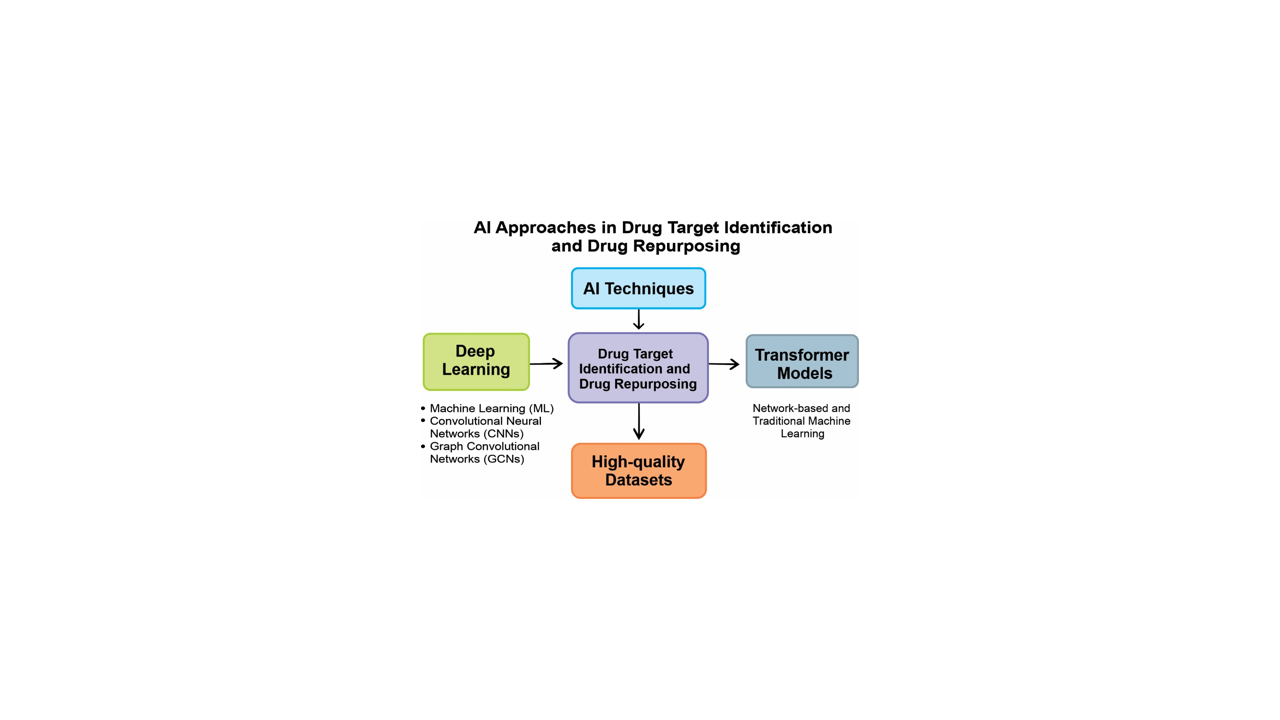
Exposure to datasets of superior quality and reliable methods for testing is critical to the effective execution of intelligence-based pharmacological target discovery. They are necessary to guarantee precise and trustworthy forecasts during the pharmaceutical development process (Mullowney et al., 2023). Using cutting-edge methods like deep learning, machine learning (ML), convolutional neural networks (CNNs), graph convolutional networks (GCNs), and transformer models in addition to neural-related and standard machine learning approaches, AI has become essential in pharmaceutical target detection and drug repurposing. These techniques improve generalizing the models and precision of forecasting, successfully detecting drug-target associations, involving intricate, numerous medication interactions (Fig. 1). AI outperforms conventional techniques in the analysis of large physiological collections of data, encapsulating complex chemical patterns and interactions essential for the creation of drugs (Wang et al., 2025).
Omics Data Analysis
AI-enhanced innovative machine-based approach speeds up the entire drug discovery process by facilitating the peptide creation, production of new chemical entity, and small molecule discovery (Sharma et al., 2025; Zhou et al., 2024). AI makes it easier to uncover illness-associated indicators and new treatment targets by combining human-genomes, RNA-expression profiling, proteomics, and small-molecule metabolite data. This collection of data is managed and interpreted using AI approaches, including neural networks, deep learning and machine learning. AI techniques enable data standardization and amalgamation while showing physiologically appropriate trends at diverse molecular dimensions. Support vector machines, random forests, and dimensionality reduction algorithms such as principal component analysis and t-SNE are widely used to facilitate the analysis and visualization of datasets with high-dimensions. AI tools significantly improve the knowledge of the physiological mechanism by allowing route and gene classification analysis (Yetgin, 2025). By expediting the discovery of drugs, these methodologies allow for the rapid identification of prospective candidates and reduce the necessity for conventional high-throughput drug screening techniques, which is often time-consuming and expensive to obtain (Patel et al., 2020).
Machine Learning (ML)
AI technologies, particularly DL and ML, are extensively utilized to investigate enormous physiological and biochemical information sets to foresee probable connections between compounds as well as particular pharmacological targets(Patel et al., 2020). ML, a subfield of AI, entails the creation of algorithms and statistical modeling approaches that allow computers to recognize similarities in information and accomplish operations independent of additional automated instructions (Suruliandi et al., 2024). ML is being used in pharmaceutical research to forecast pharmaceutical target associations, which is an important phase towards discovering innovative pharmaceutical molecules. Open access database, including Drug Bank, PubChem, and binding database are utilized to optimize machine learning technologies. By examining variables from recognized therapeutic target association including polypeptide sequences, structural features of molecules, chemical and physical properties, these technologies discover correlations. ML can forecast if a particular medication adheres to a identifies biological target by collecting characteristics and utilizing categorization or grading techniques. ANN’s, SVM and deep learning technologies, including a convolutional neural network, demonstrated outstanding efficiency in recognizing complicated interactions, thus boosting the dependability of therapeutic-target correlations (Xu et al., 2021).
The algorithms used for machine learning evaluate current information to identify similarities and make recommendations. They are used for a variety of functions throughout the course of the discovery of therapeutics. ML methods encompassing SVM, RF, and NB are important technologies in therapeutic target recognition. These approaches are used across the process of developing new therapeutics, from the beginning with recognition to lead compound development. ML examines complicated physiological and biochemical information sets, encompassing molecular genetics, gene expression analysis, and protein profiling, to facilitate accurate pharmaceutical medicines. Random Forest optimizes forecasts by eliminating anomalies and categorizing major characteristics. Naive Bayesian classification systems manage heterogeneous physiological information sets and appropriately characterize protein-ligand associations. SVM differentiates between active and inactive compounds by constructing ideal surfaces and sorting possibilities according to performance and sensitivity. SVM kernel functions assist in the modeling of information that is non-linear, resulting in improved precision. ML may additionally be employed for repositioning of drugs and forecast their effectiveness and safety. It is significant in QSAR simulations for potential drug leads. Incorporating various ML algorithms with massive datasets and numerous omics information enhances the productivity and reliability of pharmaceutical candidates’ research, decreasing expenses and accelerating the research (Patel et al., 2020).
Deep Learning
Drug-target interaction prediction is commonly framed as a binary classification task, with computational approaches providing a much faster alternative to traditional experimental screening methods. Deep learning, a subfield of machine learning (ML), significantly contributes to drug-target identification by automatically extracting meaningful information from huge, complicated medical datasets, leading to more precise and efficient predictions (Yetgin, 2025). Deep learning models are particularly good at analyzing multimodal data by combining information from multiple sources, including the chemical structure of drugs and sequence data of their targets, resulting in more precise and robust predictions (Nagarajan and Ponkumar, 2025). It has been demonstrated that the Deep-Avpiden model, which makes use of temporal convolutional networks (TCNs), performs better than traditional recurrent neural networks in tasks involving the categorization of antiviral peptides. These advancements demonstrate the efficacy of deep learning as a potent strategy for enhancing drug-target interaction and combination therapy predictions (Huang et al., 2024). By making it easier to create small molecules, synthesize peptides, and generate new compounds, AI-enhanced computational tools improve early-stage drug design and ultimately expedite the drug discovery process (Sharma et al., 2025; Zhou et al., 2024).
Convolutional Neural Networks (CNNs)
Convolutional Neural Networks (CNNs) use raw drug and protein data to capture and analyze complex aspects in order to predict drug-target interactions. They convert amino acid sequences and drug SMILES strings into matrices or sequence representations that can be used with convolution techniques. For example, protein sequences are processed similarly to text to identify important residue patterns, whereas SMILES can be represented as 2D matrices to encode chemical structures. Drug and protein data are processed by separate CNNs in models such as Deep DTA, which then combine the results to calculate binding affinity. Similar to this, DeepConv-DT uses convolutional layers to find significant amino acid subsequences. CNNs improve drug–target binding predictions by identifying spatial and sequential correlations, which facilitates faster drug discovery (Vaz and Balaji, 2021).
Graph Neural Networks (GNNs)
Because they work directly on chemical graphs and protein structures, which are inherently non-Euclidean data, Graph Neural Networks (GNNs) have become popular methods for predicting drug-target interactions. GNNs extract information directly from the molecular structure and geometry, in contrast to traditional machine learning methods that rely on predefined chemical and protein properties. This improves prediction accuracy by enabling them to recognize important structural and interaction patterns. By capturing intricate interactions between medicinal molecules and protein networks, graph neural networks have shown to be effective and comprehensible tools in drug development. GNN-based models are being used more frequently to enhance drug and target interaction predictions and enable more efficient drug development as biological datasets have grown (Zhang et al., 2022).
Natural Language Processing (NLP)
To extract useful information from unstructured scientific literature and clinical data, natural language processing, or NLP, is crucial. AI systems may discover drug and disorder references, find adverse effect reports, and develop treatment hypotheses using techniques like named entity recognition, topic modeling, relationship extraction, and complex transformer-based models like BERT and BioBERT. By using these methods, AI can efficiently glean insights from massive amounts of textual data, significantly improving data-driven drug repurposing efforts.
INTEGRATION OF AI AND NETWORK PHARMACOLOGY
Network pharmacology offers a strong and efficient paradigm for finding pharmacological targets when paired with AI. While network pharmacology clarifies the intricate connections between genes, proteins, and mechanisms, AI algorithms handle complex biological data. When combined, they enable more precise identification of different therapeutic targets, forecast potential adverse effects, and expedite the discovery of effective treatments by fully capturing the complex character of diseases (Wang et al., 2025).
AI-DRIVEN APPLICATIONS ACROSS THERAPEUTIC AREAS
Numerous therapeutic areas are covered by AI-based pharmacological target identification. For example, the tumor-suppressive characteristics of BKT inhibitors have been discovered by combining pharmacophore modeling with machine learning. Adenosine A1 and A2A receptors linked to Parkinson's disease have been studied using deep learning in conjunction with PharmacoDocking. The use of Support Vector Machine models to predict xenobiotic penetration of the blood-brain barrier has proven beneficial for central nervous system drug development. Biologically active molecular databases powered by machine learning have improved the prediction of receptor activity, including the RAGE receptor linked to Alzheimer’s disease. Furthermore, molecular binding for Vitamin D receptor inhibitors and cancer-related compounds such as camptothecin has been shown using ligand-specific pharmacophore modeling assisted by computational methods (Sharma et al., 2025). ML improves accuracy, speeds up responsiveness to novel diseases such as COVID-19, and significantly cuts down on the time and expense of experimental testing. The use of machine learning in the detection of drug targets is illustrated by initiatives aimed at discovering pharmacological targets for COVID-19. In this case, complicated biological datasets such as gene expression profiles, protein sequences, and protein-protein interaction pathways were analyzed using machine learning algorithms. From these analyses, the models were able to identify possible drug targets across the human proteome. While some of the discovered targets matched previously known ones, others were new possibilities that were subsequently confirmed by external databases specific to COVID-19. This example demonstrates the potential of ML-based approaches to reveal previously unrecognized targets that may be missed by conventional methodologies (Saha et al., 2022).
USE OF AI IN DEVELOPING PERSONALIZED MEDICINE
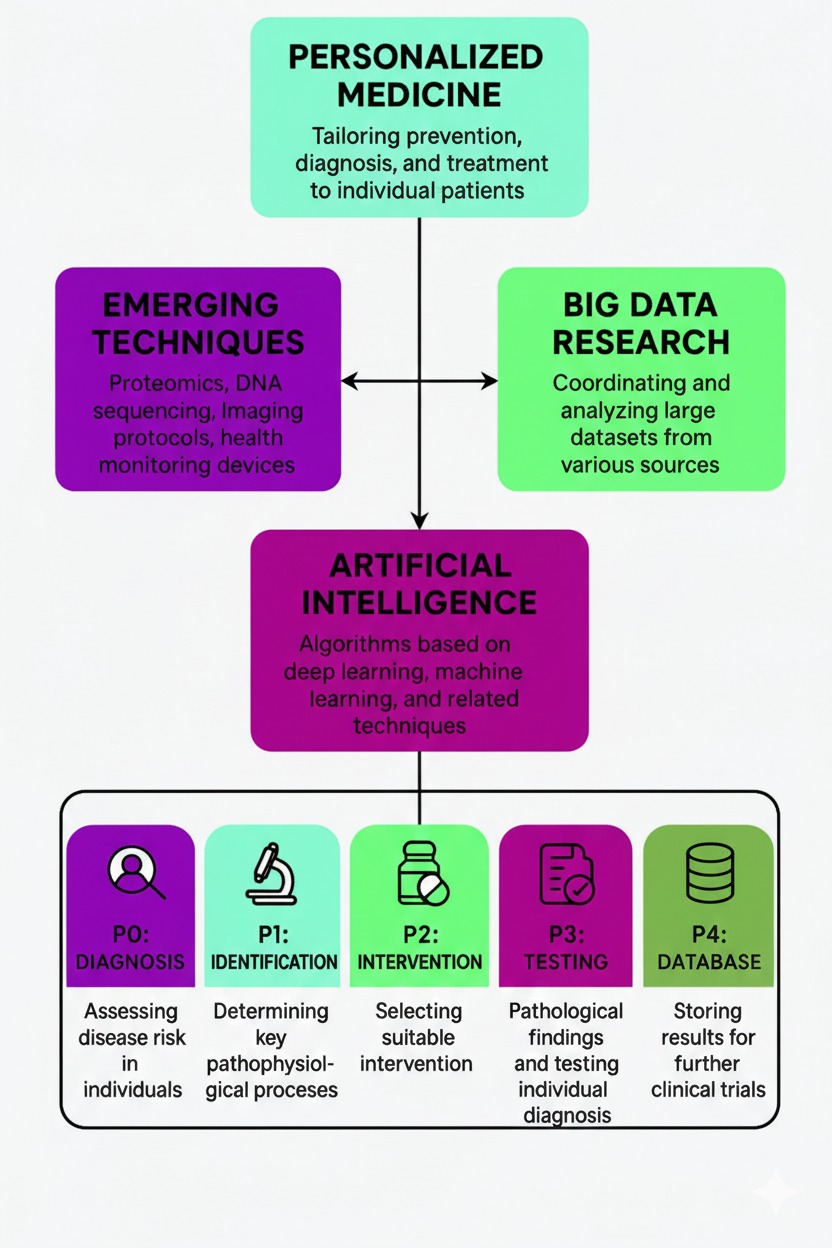
There are numerous interconnected themes that are dominant in Modern Biomedical Science. One of them is personalized medicine which means using an individual’s lifestyle, genetic makeup, and also environmental changes, we are able to regulate and monitor prevention, diagnosis, and treatment of different diseases. Its main focus is to minimize the side effects and achieve effective outcomes by giving the right treatment to the right patient at the right time. The second one is to exploit emerging techniques, such as proteomics, sequencing of DNA, imaging procedures, and also health monitoring devices. The third one is big data research models that include enormous data and emerging biomedical techniques that are gathered from different sources, coordinated, and ensure their availability for analysis. The fourth one is Artificial Intelligence, which comprises algorithms based on deep learning, machine learning, and various linked techniques that are used in massive data sets to find relevant patterns (Schork, 2019).
Four themes are extremely interconnected; for e.g., personalizing a medicine means it requires a very deep knowledge to understand the patient’s complaint and conditions, and this needs the wide use of assays that produce huge amounts of data. Though the policies and information obtained from research that are linked with all themes are needed for making generalized health items. AI will play an important role in these processes if the main focus is to personalize medicines; however, it is not clear how we link and generate accurate clinical information that can be obtained from large data-producing analyses (Mahmud et al., 2018; Webb, 2018; Fleming, 2018). In the future, AI will play an integral role in the development of personalized medicines, including all the phases of clinical development as well as the application of new health products (Fig. 2). However, there are some limitations for using AI techniques and also some deliberate areas for further research. The different phases include P0, which involves the diagnosis of the risk of diseases in individuals, P1 includes the identification of main pathophysiological procedure, P2 includes the identification of suitable intervention which was found in P0 and P1 stages, P3 includes pathological findings and testing the individual’s diagnosis; and P4 includes results findings in proper databases and information kept for further clinical trials (Schork and Nazor, 2017).
DRUG DEVELOPMENT
Artificial intelligence (AI) has pervaded several sectors, including research and pharmaceutical industries, where it can be effectively used for the identification of new chemical entities with needed properties. It has been challenging and also an amazing opportunity to use AI algorithms for drug discovery. Different new techniques, including deep learning and machine learning techniques, are helpful for the discovery and design of new drugs (Han et al., 2023; Wong and Zhang, 2023).
The union of artificial intelligence (AI) with computational chemistry has transformed drug finding by ornamental compound optimization, prognostic analytics, and molecular exhibiting AI's role in molecular display and ADMET computation. AI focuses on novel methods that enable computers to carry out a variety of tasks associated with human intelligence, such as learning and reasoning. AI is transforming many facets of our lives and a number of businesses, including the pharmaceutical sector (Chen et al., 2023; Cifci, 2023). By replacing traditional trial-based methodologies with more data-driven and rationalized approaches, advancing AI in drug discovery research is revolutionizing the sector. AI is extremely important since it may significantly cut expenses and shorten the time required for medication research. AI's function in ADMET calculation and molecular display. AI focuses on cutting-edge techniques that let computers perform a range of tasks related to human intelligence, such as learning and reasoning. AI is changing many aspects of our lives and several industries, including the pharmaceutical industry (Chen et al., 2023; Cifci, 2023).
Developing AI in drug discovery research is transforming the industry by substituting more data-driven and rationalized approaches for conventional trial-based methodologies. AI is crucial because it has the potential to drastically reduce costs and minimize the time needed for drug discovery. It is also important that AI plays an important role in predicting new uses of already present drugs; this gives another advancement to reduce cost and accelerate the drug development procedures (Xue et al., 2019; Arabi, 2021; Gupta et al., 2021).
AI IN DRUG SAFETY
Several studies revealed that AI models can improve ADR prediction and also proactive patient care approaches. Adverse drug reactions (ADRs) are a problematic risk in pharmaceutical practice, upsetting patient care and healthcare charges. ADRs account for 6.5 % of all hospital admissions alone in developing countries, and it’s the 2nd leading cause of hospitalization and increasing the extent of stay in the hospital. After the development of new medicine, ADR remains challenging in-patient safety and public health (Panda and Mohapatra, 2024). The AI is an evolving and hopeful measure to recognize, forecast, and alleviate ADRs. In clinical trial findings, healthcare findings, as well as patient data, AI models can be applied that help to find ADRs effectively and therefore implement precautionary measures. Several researches have shown that after validation and optimization of an AI model for ADR prediction can enhance the understanding and the specificity, to ensure active pharmacovigilance (Alowais et al., 2023).
For ADR prediction and pharmacovigilance, the use of AI can be reliable around the globe to increase drug safety measures. The change from a reactive to a proactive methodology is a main improvement in patient health care. It is essential to learn how effectively AI models are used for the prediction of ADRs. As the use of AI in ADR prediction is prodigious, we face certain challenges (Algarvio et al., 2025).
References
- Algarvio RC, J Conceição, PP Rodrigues et al., 2025. Artificial intelligence in pharmacovigilance: a narrative review and practical experience with an expert-defined Bayesian network tool. International Journal of Clinical Pharmacy 47:932-44.
- Alowais SA, SS Alghamdi, N Alsuhebany et al., 2023. Revolutionizing healthcare: the role of artificial intelligence in clinical practice. BMC Medical Education 23:689.
- Arabi AA, 2021. Artificial intelligence in drug design: algorithms, applications, challenges and ethics. Future Drug Discovery 3:59.
- Bhatia N, MMU Khan and S Arora, 2024. The role of artificial intelligence in revolutionizing pharmacological research. Current Pharmacology Reports 10:323-9.
- Chalkowski K, KM Pepin, MJ Lavelle et al., 2025. Operational lessons learned from simulating an elimination response to a transboundary animal disease in wild animals. Preventive Veterinary Medicine 234:106365.
- Chen W, X Liu, S Zhang et al., 2023. Artificial intelligence for drug discovery: Resources, methods, and applications. Molecular therapy Nucleic acids 31: 691-702.
- Cifci MA, 2023. A deep learning-based framework for uncertainty quantification in medical imaging using the DropWeak technique: An empirical study with Baresnet. Diagnostics 13:800.
- Fantini J, 2024. Fundamental mechanisms in membrane Receptology: Old paradigms, new concepts and perspectives. Receptors 3:107-21.
- Fleming N, 2018. How artificial intelligence is changing drug discovery. Nature 557:55-57.
- Gupta R, D Srivastava, M Sahu et al., 2021. Artificial intelligence to deep learning: machine intelligence approach for drug discovery. Molecular Diversity 25:1315-60.
- Gupta U, A Pranav, A Kohli et al., 2024. The contribution of artificial intelligence to drug discovery: Current progress and prospects for the future. In: Microbial Data Intelligence and Computational Techniques for Sustainable Computing (Khamparia A, B Pandey, DK Pandey, D Gupta, Eds.): Springer, Singapore, pp:1-23.
- Han R, H Yoon, G Kim et al., 2023. Revolutionizing medicinal chemistry: the application of artificial intelligence (AI) in early drug discovery. Pharmaceuticals 16:1259.
- Huang D, M Yang and W Zheng, 2024. Integrating AI and deep learning for efficient drug discovery and target identification. Preprints 2024:2024101089.
- Jain A and Z Adenwala, 2025. The role of artificial intelligence in pharmacovigilance for rare diseases. Expert Opinion on Drug Safety 24:893-8.
- Mahmud M, MS Kaiser, A Hussain et al., 2018. Applications of deep learning and reinforcement learning to biological data. IEEE Transactions on Neural Networks and Learning Systems 29:2063-79.
- Mullowney MW, KR Duncan, SS Elsayed et al., 2023. Artificial intelligence for natural product drug discovery. Nature Reviews Drug Discovery 22:895-916.
- Nagarajan P and DDN Ponkumar, 2025. Deep learning-based drug discovery and molecular analysis accelerating the future of medicine. 2025 3rd International Conference on Communication, Security, and Artificial Intelligence (ICCSAI), Greater Noida, India, 2025, pp: 984-9.
- Panda P and R Mohapatra, 2024. Revolutionizing patient safety: machine learning and AI for the early detection of adverse drug reactions and drug-induced toxicity. Current Artificial Intelligence 2:29503752308394.
- Patel L, T Shukla, X Huang et al., 2020. Machine learning methods in drug discovery. Molecules 25:5277.
- Pinzi L, N Bisi and G Rastelli, 2024. How drug repurposing can advance drug discovery: challenges and opportunities. Frontiers in Drug Discovery 4:1460100.
- Saha S, P Chatterjee, AK Halder et al., 2022. ML-DTD: machine learning-based drug target discovery for the potential treatment of COVID-19. Vaccines 10:1643.
- Salas M, J Petracek, P Yalamanchili et al., 2022. The use of artificial intelligence in pharmacovigilance: a systematic review of the literature. Pharmaceutical Medicine 36:295-306.
- Schork NJ and K Nazor, 2017. Integrated genomic medicine: a paradigm for rare diseases and beyond. Advances in Genetics 97:81-113.
- Schork NJ, 2019. Artificial intelligence and personalized medicine. In: Precision Medicine in Cancer Therapy (Von Hoff D and H Han, Eds.): Springer, Singapore, pp: 265-83.
- Sharma K, V Srivastava and RK Singh, 2025. From data to cures: leveraging machine learning, deep learning and pharmacore modelling for targeted therapies. Paper presented at the AIP Conference Proceedings, 5 February 2025, 3254:020008
- Singh H, DK Nim, AS Randhawa et al., 2024. Integrating clinical pharmacology and artificial intelligence: potential benefits, challenges, and role of clinical pharmacologists. Expert Review of Clinical Pharmacology 17:381-91.
- Suruliandi A T Idhaya and S Raja, 2024. Drug target interaction prediction using machine learning techniques-a review. International Journal of Interactive Multimedia and Artificial Intelligence 8:86-100.
- Vaz JM and S Balaji, 2021. Convolutional neural networks (CNNs): concepts and applications in pharmacogenomics. Molecular Diversity 25:1569-84.
- Wang B, T Zhang, Q Liu et al., 2025. Elucidating the role of artificial intelligence in drug development from the perspective of drug-target interactions. Journal of Pharmaceutical Analysis 15:101144.
- Webb S, 2018. Deep learning for biology. Nature 554:555-7.
- Wong J and Q Zhang, 2023. Deep learning of sparse patterns in medical IoT for efficient big data harnessing. IEEE Access 11:25856-64.
- Xu L, X Ru and R Song, 2021. Application of machine learning for drug-target interaction prediction. Frontiers in Genetics 12:680117.
- Xue D, Y Gong, Z Yang et al., 2019. Advances and challenges in deep generative models for de novo molecule generation. Wiley Interdisciplinary Reviews: Computational Molecular Science 9:1395.
- Yetgin A, 2025. Revolutionizing multi‐omics analysis with artificial intelligence and data processing. Quantitative Biology 13:70002.
- Zhang Z, L Chen, F Zhong et al., 2022. Graph neural network approaches for drug-target interactions. Current Opinion in Structural Biology 73:102327.
- Zhou G, DV Rusnac, H Park et al., 2024. An artificial intelligence accelerated virtual screening platform for drug discovery. Nature Communications 15:7761.